
How to Review SAT Wrong Answers After Practice
Use a 5-step routine to find the first wrong step, label the error, write one corrective action, and retest with new SAT questions.
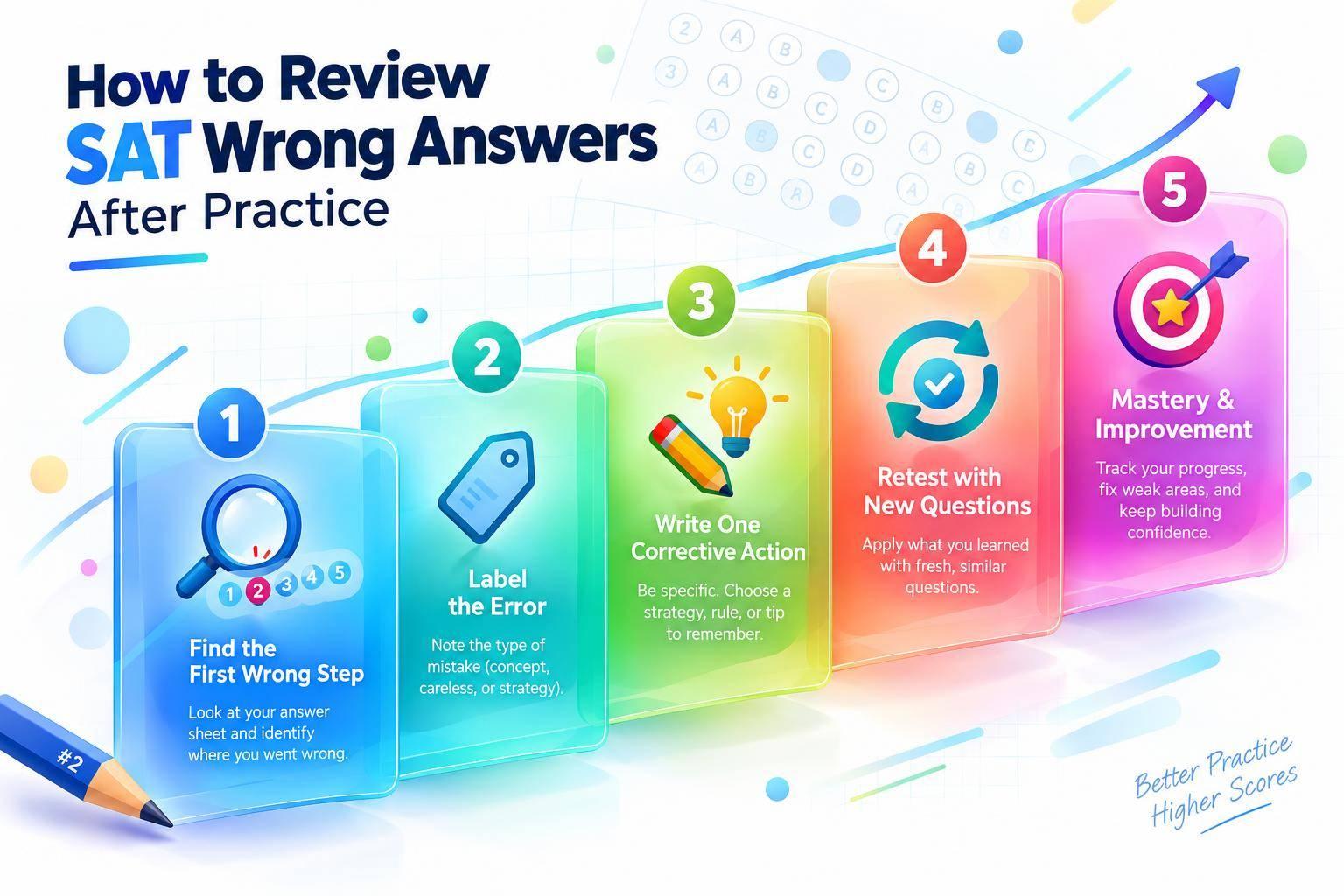
How to Review SAT Wrong Answers After Practice
I review SAT mistakes by finding the first wrong step - not just checking the correct answer. After practice, I include missed questions, lucky guesses, and slow correct answers.
I use this 5-step routine:
- Retry with the answer and explanation hidden.
- Label the skill and what caused the mistake.
- Read the explanation and check my reasoning.
- Write one specific action to use next time.
- Test that action on 3–6 new questions, then retry the original later.
My error log stays short: what went wrong, what I’ll change, and whether the mistake returns. A correct guess isn’t proof I know the skill - I need to explain my answer on my own.
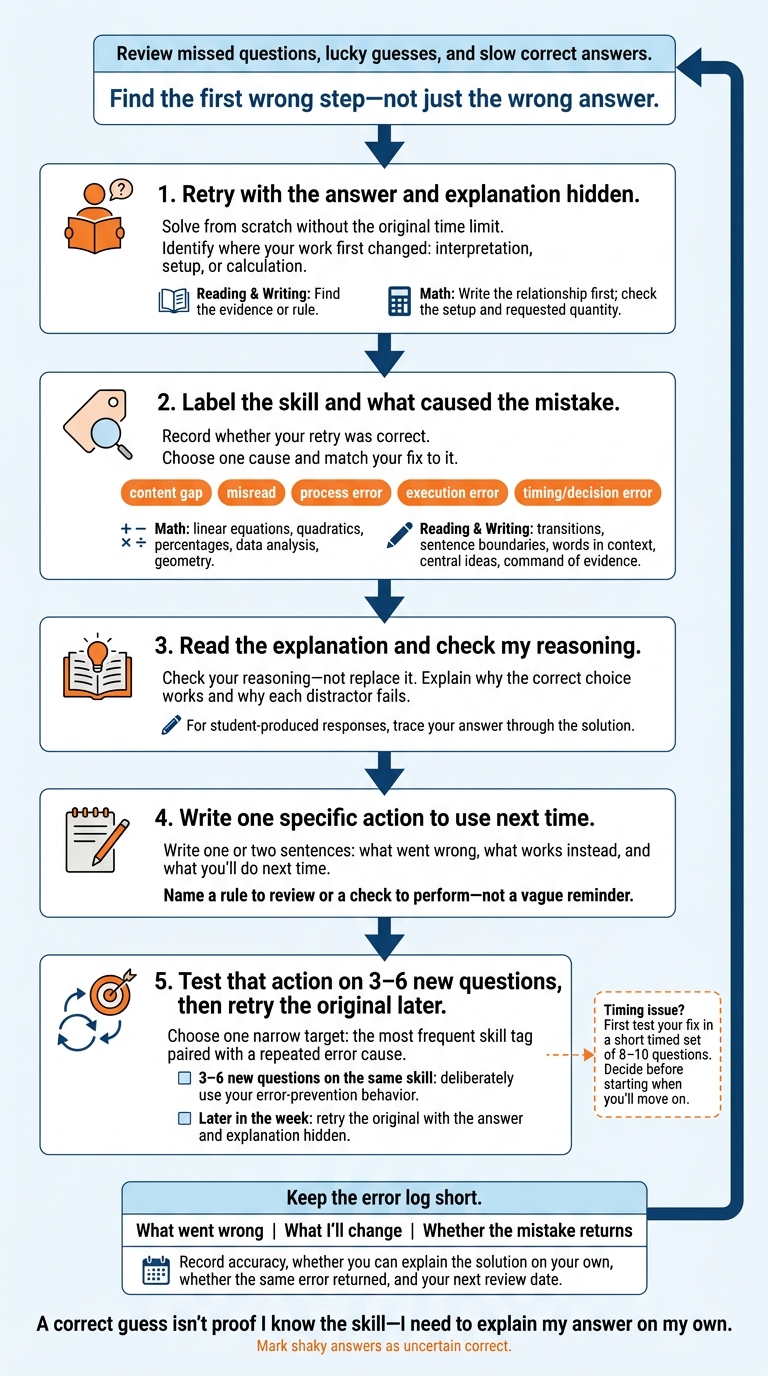
SAT Mistake Review: A 5-Step Routine
Step 1: Retry Without the Explanation
Reread the question and solve it from scratch, without the original time limit. Write your new answer and note where your work first changed: interpretation, setup, or calculation. Find the first wrong step, not just the wrong answer. If you’re still stuck, mark that point for closer review instead of guessing again.
Use this reset-and-check process for every question type.
Reading & Writing: Find the Evidence or Rule
For evidence and inference questions, identify the exact sentence, phrase, or data point that supports your choice. Don’t add assumptions the text doesn’t support. For vocabulary-in-context questions, try each choice in the sentence. Use the surrounding text to judge its meaning, rather than relying on a familiar definition.
For transitions, summarize the ideas on both sides of the blank. Then identify their relationship: contrast, addition, cause and effect, example, or sequence. For grammar, locate the subject, verb, and clause boundaries before applying the punctuation or agreement rule.
In Math, check your setup before judging your answer.
Math: Check Your Setup and the Target
Write the relationship first - equation, inequality, proportion, or function. Define your variables, mark what the question asks you to find, and check restrictions such as positive values or interval limits. Did you find the requested quantity, or stop at an intermediate result?
If you used a calculator, compare your entry with your written setup, including parentheses and negative signs. Check whether the output makes sense using a rough estimate. If needed, substitute your result into the original equation.
Record the first wrong step so you can sort the error in Step 2 and read the explanation faster.
Step 2: Sort Mistakes and Read Explanations
Label the Skill and Error Cause
Use the first wrong step from Step 1 to label each missed question by skill and cause. For Math, use specific tags such as linear equations, quadratics, percentages, data analysis, or geometry. For Reading and Writing, use transitions, sentence boundaries, words in context, central ideas, or command of evidence.
Record whether your retry was correct. A correct retry can help explain the mistake, but it doesn’t prove that rushing was the only problem.
Choose one cause: content gap, misread, process error, execution error, or timing/decision error. Then match your fix to that cause. Learning a method won’t fix a copying mistake, and slowing down won’t teach you a rule you don’t know.
Check Why Each Choice Works or Fails
After your retry, read the explanation to check your reasoning - not replace it. For Reading and Writing, identify the evidence or rule that supports the correct choice. Then explain each distractor’s flaw: unsupported evidence, the wrong logical relationship, an inappropriate word meaning, or a broken grammar rule. Name the evidence or rule that rules it out.
For Math, check why the correct choice works and why each distractor fails. Don’t guess how a distractor was created; point to a mismatch you can prove. For student-produced responses, trace your answer through the solution. Check the target, algebra, arithmetic, units, sign, and response format.
Write a Short Takeaway
Write one or two sentences covering what went wrong, what works instead, and what you’ll do next time. Make the action something you can check: name the rule you’ll review or the check you’ll perform.
Don’t copy the explanation or settle for a vague reminder. Save your takeaway as the rule you’ll test on the next question.
Step 3: Practice and Retest
Use your error log to choose one narrow target: the most frequent skill tag paired with a repeated error cause. Focus your practice on that target until you understand the fix. Mark any shaky answer as uncertain correct until you can explain it without guessing.
If timing is the issue, practice with a short timed set of 8–10 questions. Decide before you start when you’ll move on from a question.
Check Whether Your Fix Works
For timing problems, test your fix in a short timed set first. Answer 3–6 new questions on the same skill, deliberately using one error-prevention behavior from your takeaway.
Later in the week, retry the original question with the answer and explanation hidden. New questions check whether you can apply the skill elsewhere; the original checks whether you remember what you learned.
Record your accuracy, whether you can explain the solution on your own, whether the same error returned, and your next review date. Track repeated errors and clear reasoning - not a single lucky answer.
Review with SAT Practice Bot
Choose a practice set that includes feedback and retesting. Use SAT Practice Bot for focused practice, answer review, and progress tracking during private beta.[1]
Conclusion: Review After Every Practice Set
After every practice set, follow the same review cycle: retry, name the skill and cause, read the explanation, write one takeaway, and retest later. Include lucky guesses and slow correct answers - not just mistakes.
Start with your next missed question. Keep the explanation hidden until you’ve tried again, then write one specific action you’ll use in your next practice set.
FAQs
How can I tell a careless mistake from a skill gap?
A careless mistake is a slip: you misread a keyword, forget to check units, signs, or evidence, or pick an answer that doesn’t match what the question asks. Slowing down and rereading the question can usually help you catch it.
A skill gap is a repeated pattern: you struggle to identify the task or skill, find exact evidence in the passage, or decide which step to take. The same type of error keeps showing up. [1][2][3]
Which SAT mistakes should I review first?
Review every question you missed, guessed on, or felt unsure about - even if you got it right. Before focusing on specific question types, check your error log for repeated mistakes. Label each miss by skill and trap type so you can see what to work on first.
SAT Practice Bot offers answer explanations and progress tracking to help you target those weak points in your next practice sessions.
What should I do if the same mistake keeps returning?
Keep an error log with the question type, your chosen answer, the correct answer, and the point where your reasoning went off track. Review explanations in SAT Practice Bot to spot patterns in your mistakes.
Then set a targeted practice goal for the concept or habit you need to work on, and answer similar questions. Continue reviewing explanations until you understand the concepts, and track the steps you miss most often.