
Common SAT Answer Traps Explained
The SAT trap answers that cost the most points, like half-right, out of scope, extreme wording, sign errors, and wrong units, plus a quick check for each.
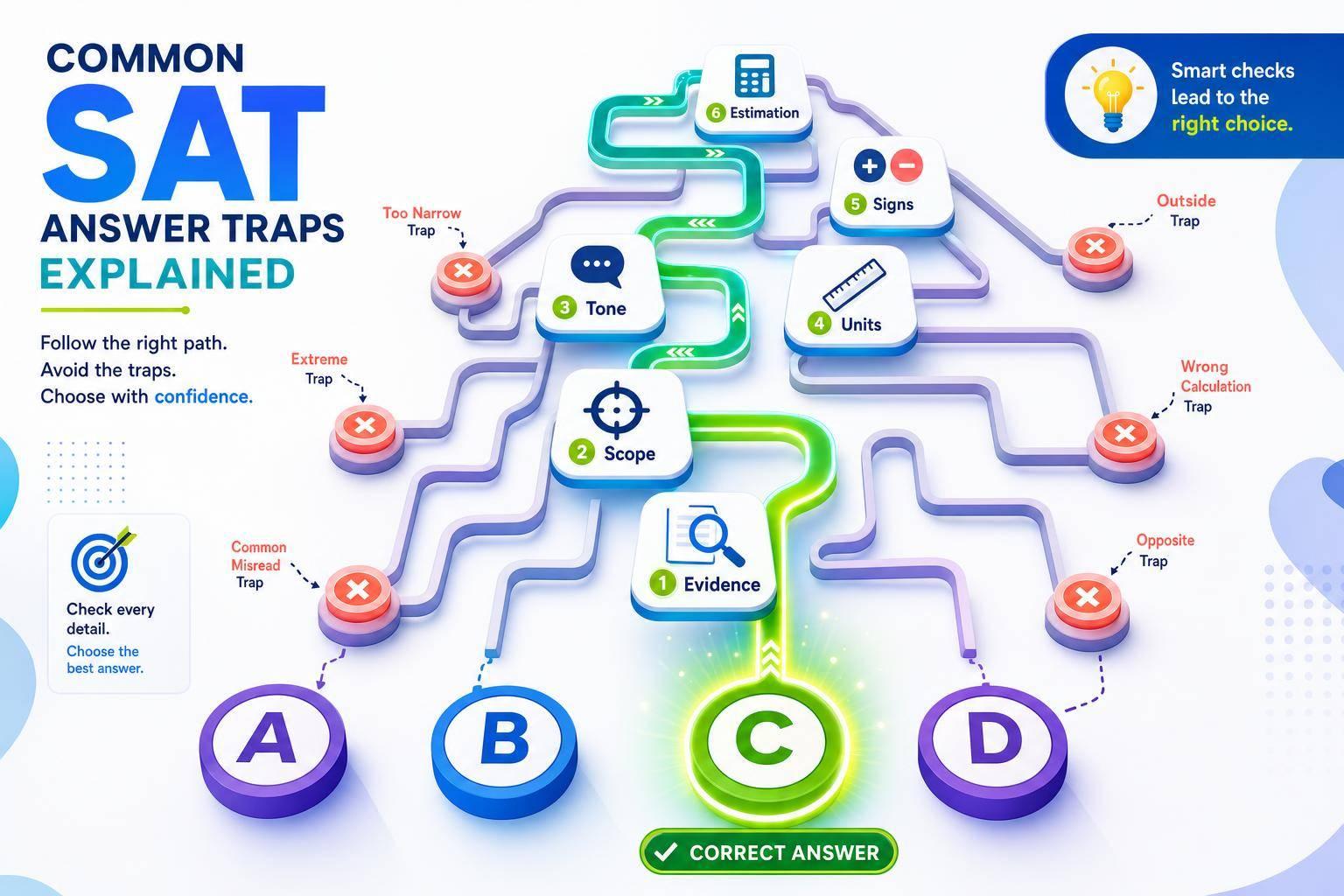
Common SAT Answer Traps Explained
SAT trap answers are choices built to look right but fail one check. In Reading and Writing, they echo the passage, are only half right, go beyond its scope, or use extreme wording. In Math, they reflect sign errors, wrong units, or an intermediate value instead of the quantity asked.
Practice Reading and Writing evidence questions, Craft and Structure, Math practice by skill, and sign and formula traps in Advanced Math.
Most SAT trap answers fail one simple check: they do not fully match the question, the text, or the math. If I slow down for a few seconds and check evidence, scope, tone, units, signs, and the exact quantity asked, I can cut many wrong choices fast.
Here’s the short version for the current digital SAT:
-
In Reading and Writing, trap answers often:
- repeat passage words but twist the meaning
- include one correct part and one wrong part
- sound plausible but lack proof
- answer a different question than the one asked
- use tone that is too strong
- use extreme words like “always” or “never”
-
In Math, trap answers often come from:
- the wrong operation
- a missed negative sign
- the wrong formula
- solving for the wrong value
- missing a unit change
- misreading a graph scale
-
My best routine is:
- Restate the task
- Predict the answer
- Prove it with the text or math
On SAT multiple-choice questions, 75% of the choices are wrong by design. That is why trap patterns matter so much. On the digital SAT, using a short repeatable check can help me make fewer rushed mistakes and use my time better in both modules.
| Section | Common trap | Fast check |
|---|---|---|
| Reading and Writing | Echoed wording | Check meaning, not repeated words |
| Reading and Writing | Half-right choice | If one part is wrong, cut it |
| Reading and Writing | Tone/scope error | Match the author’s tone and the question’s job |
| Math | Sign/operation slip | Recheck setup before calculating |
| Math | Wrong quantity or unit | Underline what the question asks for |
| Math | Graph scale mistake | Read labels and increments first |
If I treat every answer like it has to earn my pick, trap choices lose a lot of their power.
Common trap patterns in SAT Reading and Writing
In SAT Reading and Writing, wrong answers often sound right because they borrow words from the passage while twisting the meaning. That’s the trap. The test rewards close reading, not just word matching.
The most common wrong-answer patterns come from wording, scope, and tone.
Passage echo, half-right answers, and unsupported claims
A passage echo answer repeats words or phrases from the text, so it feels familiar. But familiar does not mean correct. Check whether the answer matches the passage’s idea, not just its wording [2].
Half-right answers are one of the easiest ways to lose points. Part of the choice is correct, but another part is wrong or not backed up by the passage. On the digital SAT, that means the whole answer has to go. If one piece fails, the choice fails [2].
Unsupported claims often sound reasonable, which is why they can fool students. A choice might say a tool became “popular” or a character felt “conflicted.” Maybe that could be true, but if the passage does not state it or point to it, you can’t pick it. Find the line that proves the claim. If you can’t, eliminate it [3].
True but irrelevant, scope shifts, and extreme wording
Some wrong answers are factually correct but still miss the question. A true but irrelevant choice uses a real detail from the passage, yet it does not answer what the question asks. This shows up a lot on main idea or main purpose questions, where a choice zooms in on one supporting detail instead of the passage’s bigger point [3].
Scope shifts work in a similar way. An answer may get too narrow by locking onto one small detail, or too broad by going past what the passage supports. The fix is simple: check whether the choice matches the job the passage is doing.
Extreme wording is another red flag. Words like “always” and “never” can make an answer sound bold, but SAT passages rarely support that kind of all-or-nothing claim [1]. When you see absolute language, slow down and test it against the passage.
Tone mismatch and quick elimination checks
A tone mismatch happens when an answer gets the subject right but misses the author’s attitude. If the passage sounds neutral, careful, or tentative, an answer that says the author “demands” or “establishes” something is too strong [2]. In plain English: a calm passage usually does not lead to a forceful answer.
Here’s a quick reference:
| Trap Type | What to watch for | Quick check |
|---|---|---|
| Passage Echo | Uses keywords from the text but shifts the meaning | Verify meaning, not just vocabulary |
| Half-Right | One part is supported; another is flawed or unsupported | If any part is wrong, eliminate the whole choice |
| Unsupported Claim | Plausible but never stated or implied in the passage | Find the line that proves it; if none exists, eliminate |
| True but Irrelevant | A correct detail that doesn't answer the question | Ask whether it answers the question or just repeats a detail |
| Scope Shift | Too narrow to one detail or too wide for the passage | Check whether it matches the passage's overall function |
| Extreme Wording | Absolute words like "always" or "never" | Check whether the passage fully supports a 100% claim |
| Tone Mismatch | Topic fits, but the intensity or attitude doesn't | Match the answer's tone to the passage's tone |
The same elimination mindset helps in Math too, but there the traps tend to show up in setup, units, and calculation mistakes.
Common trap patterns in SAT Math
SAT Math traps usually come from setup mistakes, not misreading the passage or graph. In other words, the test often rewards students who pause and check operations, signs, formulas, units, and directions before they answer. One of the fastest ways to avoid these traps is simple: throw out choices that match the wrong operation, sign, unit, or scale. If you know the patterns, you can eliminate bad answers much faster [5].
Operation errors, sign mistakes, and wrong-formula traps
A lot of SAT Math traps are built from mistakes students already make on their own.
Operation errors happen when you use the wrong math step, like adding instead of multiplying, or dividing when the problem calls for subtraction. The trap answer is often the result of that exact slip.
Sign errors can be even trickier. Miss a negative sign while distributing, or change a sign when moving a term across an equation, and you may get an answer choice that looks perfectly fine. To avoid that, use scratch paper and track negatives one step at a time. Then use the Bluebook calculator to check the arithmetic [4].
Wrong-formula traps show up a lot in geometry and trigonometry. That’s why the SAT reference sheet matters. Even if you think you know the formula, take a second to check it before solving [5].
Once your setup is correct, the next set of traps usually comes from answering the wrong thing or pulling the wrong number from a graph.
Instruction, unit, and scale traps
These traps don’t depend on a bad calculation. They catch students who do the math right but answer the wrong question.
An instruction trap happens when you solve for the wrong quantity. For example, you find x even though the question asks for x + 2. A small habit helps a lot here: underline exactly what the problem wants before you look at the choices [5].
Unit traps catch students who read too fast and miss labels or unit changes. A problem might give a rate in minutes but ask for hours. Or a graph might label the y-axis as “in thousands,” which means 4 stands for 4,000 [5].
Scale traps work in a similar way. If you misread an axis label or the spacing between tick marks on a scatter plot, you can head straight to the wrong answer. Before using numbers from a graph, confirm the scale [5].
After setup and units are checked, estimation becomes a strong way to rule out bad choices.
Using estimation to rule out answers before calculating
Estimation is one of the fastest ways to knock out trap answers without finishing the whole problem. If the numbers in the problem are small, choices that are way too large or too small should stand out right away. This works well for sign and size checks too. If your setup points to a negative answer, you can remove positive choices at once [5].
You can also use plug-in, back-solving, or picking numbers to test whether an answer choice fits the original equation. That’s often safer than trusting a long forward calculation [5].
Here’s a quick reference for the most common SAT Math trap types:
| Trap Type | Mistake Behind It | Fastest Way to Catch It |
|---|---|---|
| Operation/Sign Error | Dropping a negative or using the wrong operation | Use scratch paper to track each step and the Bluebook calculator to verify |
| Wrong Formula | Applying the wrong geometry or trig formula | Check the SAT reference sheet before solving |
| Wrong Quantity | Solving for x when the question asks for x + 2 or another expression | Underline the exact quantity the question asks for |
| Unit Mismatch | Ignoring labels like "in thousands" or the unit requested in the prompt | Verify the required unit before answering |
| Scale Mismatch | Misreading axis labels or increments on a graph | Confirm the graph's scale before extracting data |
| Magnitude Check | Choosing an answer that is too large or too small | Use estimation to reject impossible choices before calculating |
A step-by-step process to spot and eliminate trap answers
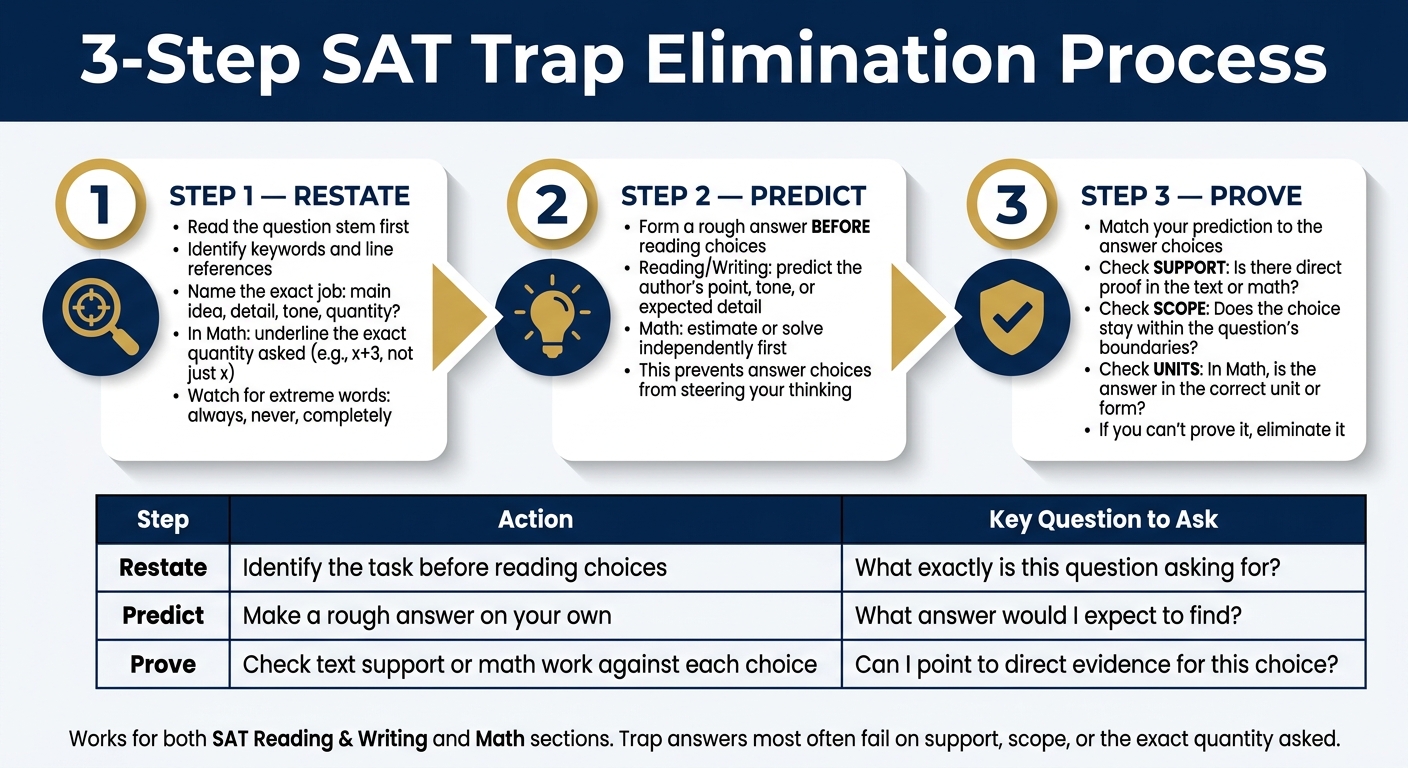
3-Step SAT Trap Elimination Process
Instinct alone won’t carry you on the digital SAT. A short routine will. Trap answers in Reading and Writing and Math tend to work when you’re rushing and reacting on autopilot. A repeatable process slows that down just enough to help you think clearly.
Restate the task before looking at the answer choices
Before you read the choices, say what the question is asking. Find the keywords, any line reference, and the exact job you need to do. A main-idea question is not checked the same way as a detail question, and the SAT often hides trap answers in that gap.
In Math, pin down the exact quantity the question wants before you solve. Underline it. If the problem asks for the value of x + 3, don’t stop at x. That sounds obvious, but it’s one of the easiest ways to lose points when you’re moving fast.
Watch for extreme wording too. Words like always, never, or completely are often wrong unless the passage or problem gives clear proof. Once you’ve named the task, you have a clean way to judge each choice.
Predict, test, and prove your answer
After you know the task, come up with a rough answer before you look at the options. This step matters because it keeps the choices from steering your thinking.
For Writing, predict a word or phrase that would fit. For Reading, predict the author’s point, tone, or the detail you expect to find. For Math, estimate or solve on your own first. Then compare that idea to the answer choices.
Now prove it. Don’t pick a choice just because it sounds close. Match it to the passage or to your math work. In both sections, use the same checks:
- Support: Is there direct proof in the text or in the math?
- Scope: Does the choice stay within what the question is asking?
- Unit match: In Math, are you answering in the right unit or form?
A trap answer often gets one of those partly right and hopes you won’t notice the mismatch.
Track your trap mistakes with an error log
After a practice set, stop and label the mistake before you move on. A score report tells you what you missed. It doesn’t tell you why. That’s where an error log helps.
Write down the trap type and the exact step where things went off track. Maybe you keep picking answers in Reading and Writing that are true but don’t answer the question. Maybe in Math you solve correctly but miss a unit conversion or answer the wrong quantity.
That’s how patterns start to show up. And once you can name the pattern, you can drill it instead of just doing more random questions.
The same routine works in both sections:
| Step | Action |
|---|---|
| Restate | Identify the task before reading choices |
| Predict | Make a rough answer on your own |
| Prove | Check text support or math work against each choice |
Conclusion: How to stop falling for common SAT answer traps
SAT traps are built around the same few mistakes in Reading and Writing and Math. So the fix on test day can stay simple. Use the same checks each time: evidence, scope, tone, instructions, units, sign, and reasonableness.
Practice goes better when you label each miss by trap type. SAT Practice Bot can help you spot repeated trap patterns with explanations and progress tracking.
Key habits to carry into test day
Use this checklist when time feels tight:
- Slow down at the question stem. Name the task first, then read the answer choices after you know what the question is asking.
- Don’t trust an answer just because it feels right. If a Reading and Writing choice sounds good but has no support in the passage, cut it. In Math, throw out any answer that doesn’t match your estimate or the required units.
- Check every answer against the text, the directions, and your scratch work. When you look for proof first, those same traps stop fooling you.
FAQ
What causes most SAT Math trap answers?
Most come from setup mistakes, like the wrong operation, a missed negative sign, the wrong formula, or a unit mix-up [5].
Should I use the Bluebook calculator on SAT Math?
Yes. It can help you check arithmetic, especially after you’ve set up the problem correctly [4].
What’s the fastest way to avoid answering the wrong quantity?
Underline exactly what the question asks for before you solve [5].
Should I always predict before looking at choices?
Yes, when you can. Even a rough prediction helps you avoid getting pulled toward a slick wrong answer.
What if I can’t predict an exact answer?
That’s fine. Predict the kind of answer you need: main idea, tone, detail, equation form, or estimate.
Does this work for both digital SAT sections?
Yes. The routine fits both Reading and Writing and Math because trap answers in both sections often fail on support, scope, or the exact quantity asked.
What should I check first on a hard SAT question?
Start with the question stem. Figure out the task before you look at the choices.
What makes an SAT answer a trap?
A trap answer often looks close to right, but it breaks one key rule. It may go beyond the passage, miss the tone, use the wrong unit, or fail a quick estimate.
How do I get better at avoiding traps?
Label your mistakes. If you know whether you missed evidence, scope, sign, or units, patterns show up fast.