
SAT Correlation vs Causation Examples
Correlation vs causation examples from school, science, and everyday life, plus how SAT questions test the difference and a 5-step checklist for causal claims.
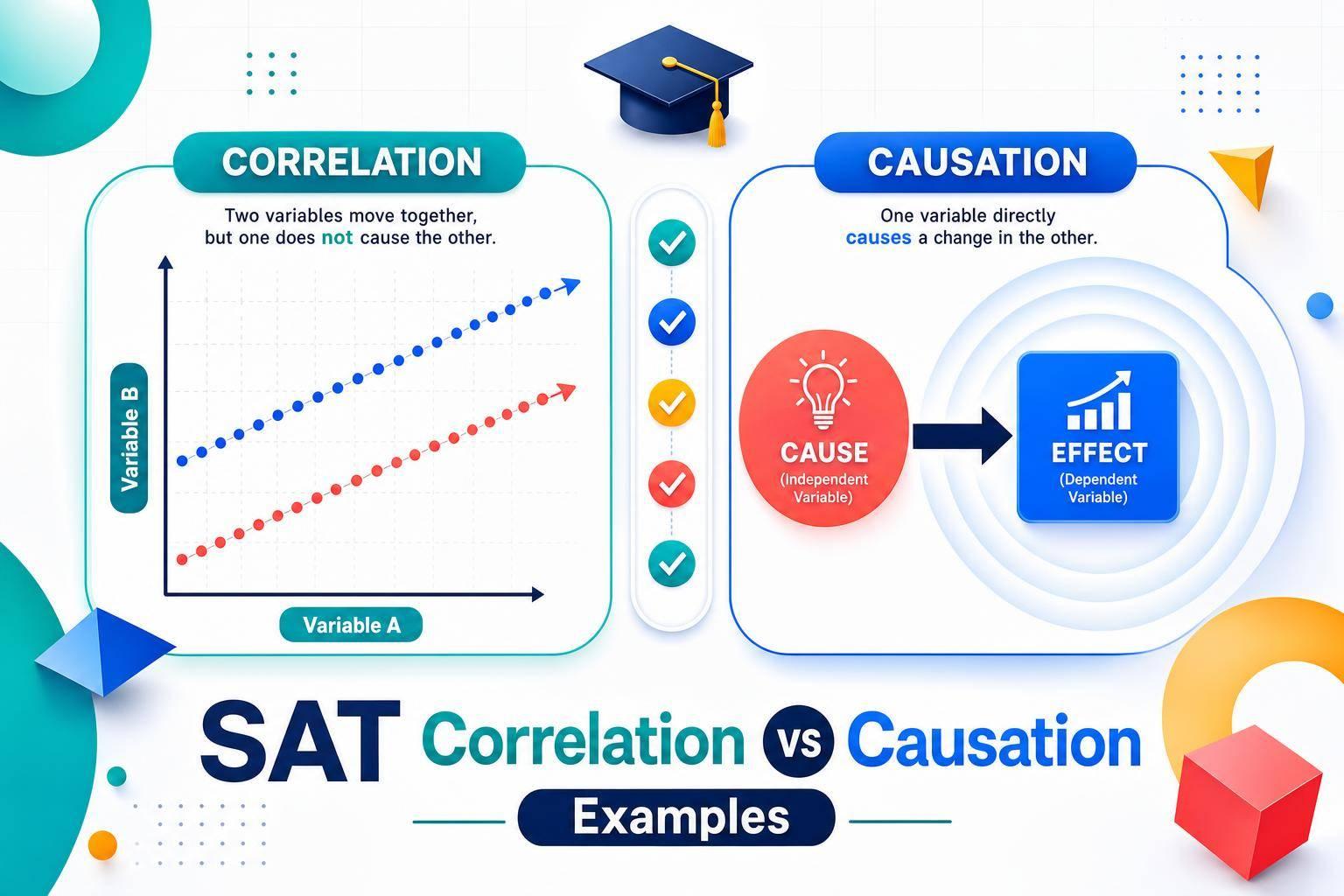
SAT Correlation vs Causation Examples
Correlation means two things change together. Causation means one actually produces the other. On the SAT, an answer that says a study “proves” or “caused” something is usually wrong when the data only shows a pattern. Check for third variables, reversed direction, and study design before you accept a causal claim.
A lot of SAT Reading and Writing questions hinge on one simple mistake: a passage shows a pattern, then acts like it proved a cause. On the digital SAT, I treat that as a warning sign right away.
Here’s the short version:
- Correlation = two things change together
- Causation = one thing directly makes the other change
- Observational data can show a link, but not cause by itself
- Random assignment + control group give much stronger support for cause
- Common traps include third variables, reverse causation, and selection bias
If I see words like caused, led to, or produced, I stop and ask:
- What are the two variables?
- Did the passage only show an association?
- Could something else explain both results?
- Could the direction run backward?
- Did the study use an experiment or just observe people?
Best SAT rule: if the evidence is weak, the right answer is usually weaker too. That means choices with associated with, linked to, or related to often fit better than strong cause-and-effect wording.
A few examples show the pattern fast:
- Attendance and scores: motivation or home support may affect both
- Reading and vocabulary: strong readers may choose to read more
- Ice cream and drowning: hot weather may drive both trends
- Spending and test scores: community wealth may affect both
- Sleep and scores: stress may affect both
According to the College Board, the digital SAT Reading and Writing section tests how well you interpret claims, evidence, and reasoning across short passages and questions. That is exactly why this skill matters on test day.
Use this article as a fast guide to spotting when a passage goes too far.
Correlation vs causation: the quick definition
- Correlation: X and Y move together, for example ice cream sales and sunburns.
- Causation: changing X changes Y, which is usually shown by a controlled experiment.
- SAT test: Does the evidence only show “linked,” or does it show “caused”? Pick the answer whose wording matches the strength of the evidence.
Practice Command of Evidence and data questions in Reading and Writing, and data and study-design questions in Math.
School examples: attendance, reading, and test scores
Here are two common SAT traps.
Attendance and exam scores
Claim: Students with higher attendance earn higher exam scores, so attending class more often caused the higher scores.
Logic gap: A third factor could explain both results. A student who is more motivated, more prepared, or has more support at home might attend class more often and score higher.
Best reasoning move: If the study does not control outside factors, treat the link as an association, not proof of cause.
Reading time and vocabulary scores
Claim: Students who read more have stronger vocabulary scores, so reading more caused higher vocabulary scores.
Logic gap: This may be reverse causation. Students with stronger language skills may be more likely to read more in the first place, so the cause could run the other way.
Best reasoning move: If the data only show that two things move together, pick "associated with" instead of "leads to" or "produces."
This same error shows up in science questions too. Hidden variables, reverse causation, and weak study design can all make a causal claim fall apart.
Science examples: third variables and study design
Science questions use the same cause-and-effect trap, just with topics like weather, health, and experiments. On the digital SAT, the issue often comes down to a third variable or a weak study design.
Ice cream sales, drowning deaths, and sunburns
Claim: Communities with higher ice cream sales also report more drowning deaths, so buying ice cream increases the risk of drowning.
Logic gap: That doesn’t follow. The more likely cause is hot weather. When temperatures go up, people buy more ice cream and also spend more time swimming, which can lead to more drowning deaths. Temperature is the third variable pushing both trends in the same direction.
Best reasoning move: Look for one shared cause behind both patterns.
A simple way to think about it: ice cream doesn’t cause drowning any more than sunscreen causes sunburn. Summer heat sits in the background and affects both.
The same rule shows up in research questions too. A claim about cause needs a study that can support it.
Treatment and cholesterol levels
Claim: Participants who received a new treatment had lower cholesterol, so the treatment caused the improvement.
Logic gap: That claim is too strong unless the study used random assignment and a control group. Without those parts, other factors could explain the result. For example, the treatment group might already have had different habits, diets, or health conditions. An observational comparison can show a connection, but it cannot prove cause.
Best reasoning move: Check the study design before you accept a causal claim. If the passage describes an observational comparison, safer answer choices usually say “associated with” or “linked to” instead of “caused.”
On SAT science passages, a good shortcut is this: if the design doesn’t control other factors, don’t jump to cause.
FAQ
What is a third variable?
It’s a hidden factor that affects two things at once, making them look connected.
Does correlation prove causation?
No. A correlation means two things vary together. It does not show that one made the other happen.
What study setup supports a causal claim best?
A controlled experiment with random assignment and a control group.
Social examples: spending, sleep, and writing the right conclusion
Social SAT passages often use data about schools, neighborhoods, or student habits. The main trap is simple: a passage shows a pattern, then jumps to a cause.
Education spending and test scores
Claim: Districts that spend more per student also have higher test scores, so increased spending caused the improvement.
Logic gap: Spending and scores might both go up because of a third factor, such as community wealth. Wealthier communities often have more support, both inside and outside school, and that can affect school budgets and student performance. If the study did not control for those other factors, the data shows a relationship, not proof of cause.
Best reasoning move: Check what the study actually controlled for. If the passage does not rule out other causes, the safer conclusion is that spending is associated with higher scores, not that it caused them.
Sleep hours and test performance
Claim: Students who sleep 8 hours score higher on standardized tests than students who sleep 5 hours, so the extra sleep caused the score difference.
Logic gap: Sleep and test scores may both be shaped by something else, such as stress. A student who sleeps less may also be dealing with more pressure, and that pressure can hurt test performance. So the evidence shows a link, not proof that sleep by itself caused the difference.
Best reasoning move: If the passage does not rule out other explanations, pick language that shows association, not cause.
Here’s how to rewrite conclusions so they fit the evidence:
| Observed relationship | Possible alternative explanation | Appropriate conclusion |
|---|---|---|
| More spending → higher scores | Community wealth affects both | Spending is associated with higher scores |
| 8 hours of sleep → higher scores | Stress affects both | Extra sleep is linked to higher scores |
A good SAT habit is to ask, What else could explain this result? That one question can keep you from picking an answer that goes too far.
SAT reasoning moves to use on test day
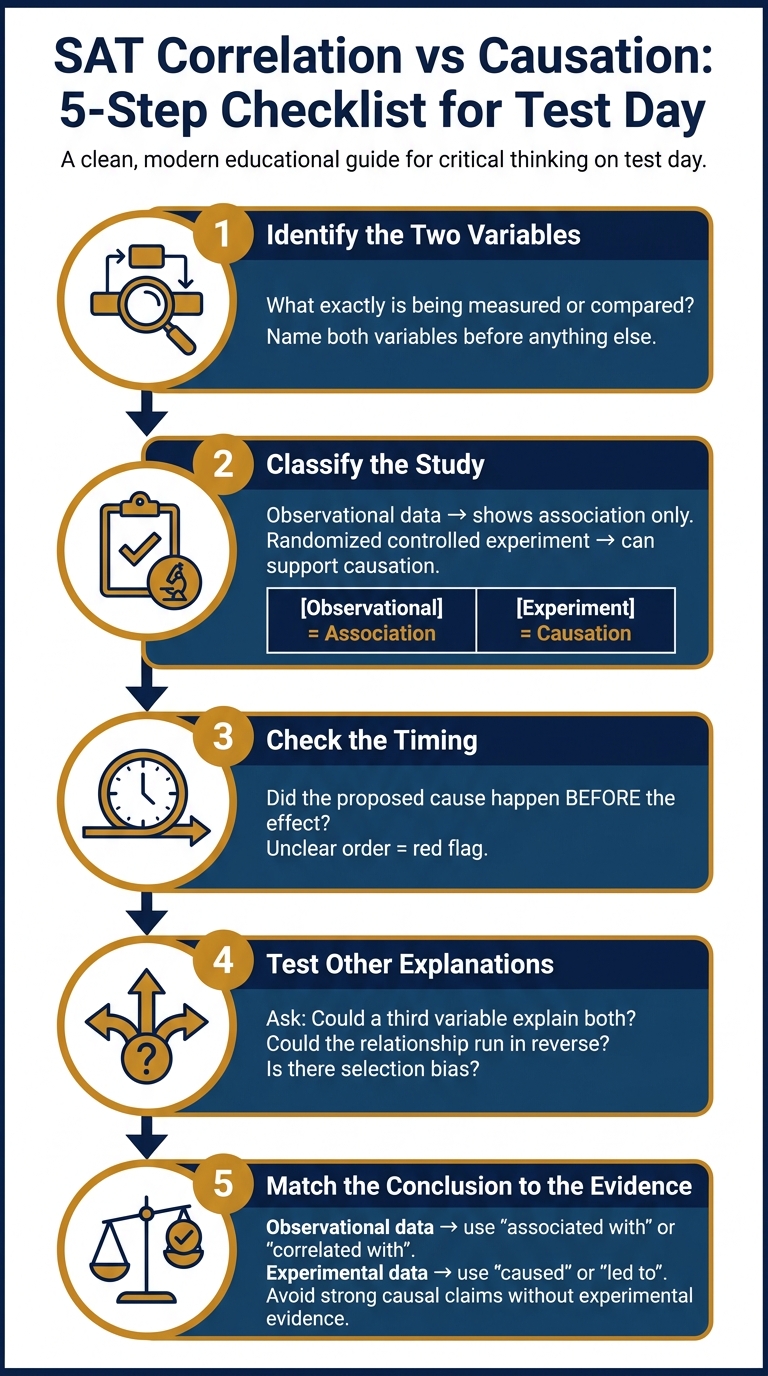
SAT Correlation vs Causation: 5-Step Checklist for Test Day
After the examples, the test-day move is simple: check whether the passage proves cause or only shows a pattern. Use this anytime a passage turns a relationship into a cause.
A 5-step checklist for causal claims
- Identify the two variables. What, exactly, is being measured or compared? Name both before you do anything else.
- Classify the study. Observational data shows association. A randomized controlled experiment can support causation.
- Check the timing. Did the proposed cause happen before the effect? If the passage is unclear about the order of events, that’s a red flag.
- Test other explanations. Could a third variable explain both? Could the relationship run in reverse? Is there selection bias?
- Match the conclusion to the evidence. Observational data supports “associated with” or “linked to.” Only controlled experimental data justifies “caused” or “led to.”
Correlation shows a relationship; causation requires a study design that rules out other explanations.
Quick check
A researcher found that cities with more miles of bike lanes have lower rates of heart disease. Which conclusion is best supported?
(A) Building bike lanes lowers heart disease rates.
(B) More bike lanes are associated with lower heart disease rates in these cities.
(C) Heart disease causes cities to build fewer bike lanes.
(D) Bike lanes have no relationship to heart disease.
Answer: (B). The data are observational, so they show an association. (A) claims cause, (C) reverses the direction with no evidence, and (D) contradicts the data.
Practice these moves with SAT Practice Bot
Use the checklist on practice questions until the habit becomes automatic. You can practice this skill with SAT Practice Bot, which offers curated digital SAT Reading and Writing and Math questions, explanations after grading, answer review, and progress tracking, free during its private beta. Claim-and-evidence questions are in Information and Ideas. Questions about whether a study supports a conclusion also appear in Math's Problem-Solving and Data Analysis domain.
Tip: if an answer choice sounds stronger than the evidence, it’s often wrong.
Conclusion: Key points to take away
Correlation means variables move together, not that one caused the other. Watch for common causes, reverse causation, and selection bias. On the digital SAT, the best answer matches the evidence exactly.
FAQ
What wording usually signals correlation, not causation?
Look for phrases like associated with, linked to, or related to.
When can a passage support causation?
Usually when it describes a controlled experiment, especially one with random assignment.
What is reverse causation?
It means the supposed effect may actually be causing the supposed cause.