
Cause and Effect in SAT Reading
Spot cause and effect in SAT Reading passages: causal signal words, how to separate causation from chronology and correlation, and a 4-step method.
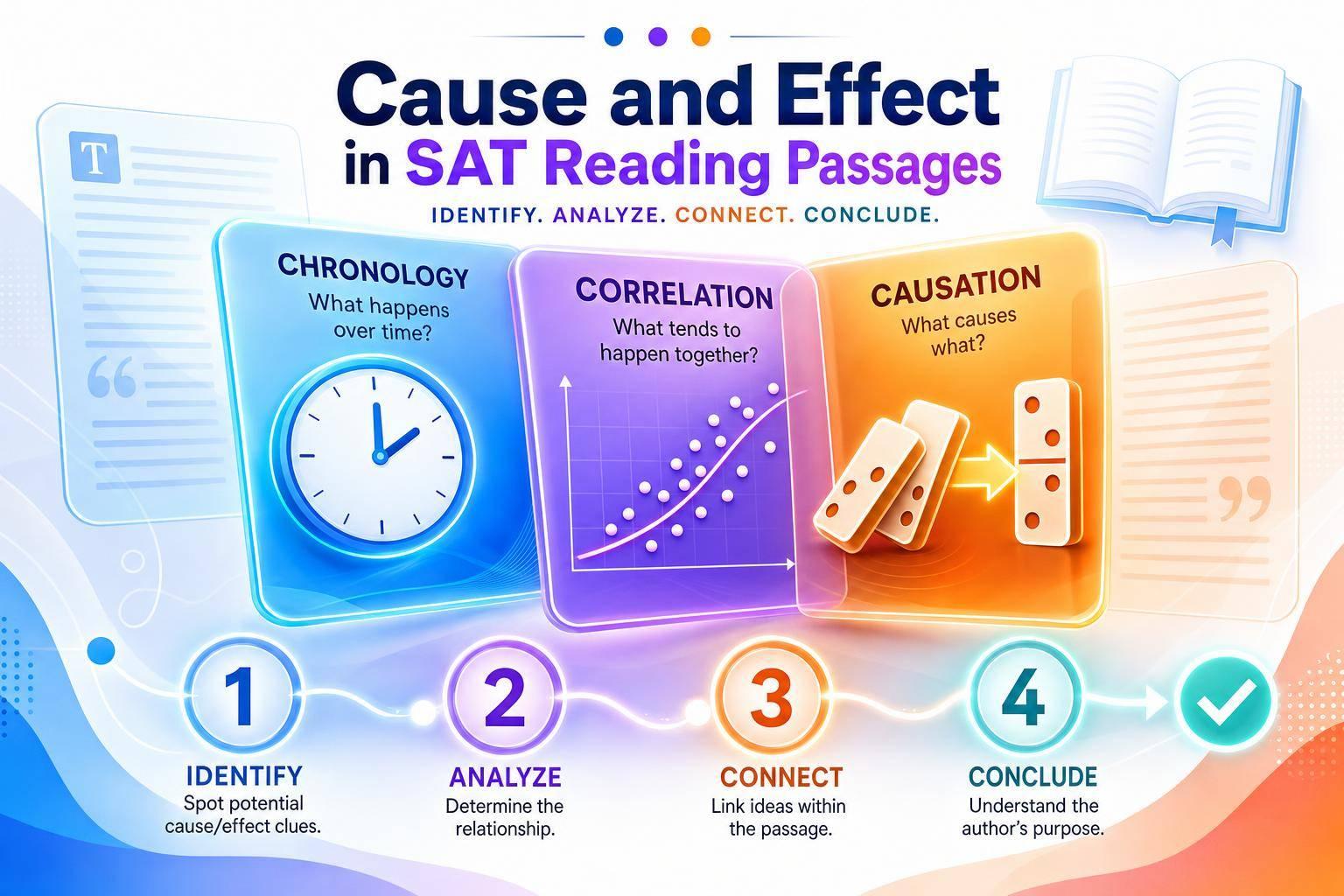
Cause and Effect in SAT Reading
Cause-and-effect questions on the SAT ask whether one event actually produced another, or only came first or appeared alongside it. Look for causal signal words like because, so, therefore, and led to. Then confirm the passage supports that link. Answers that reverse cause and effect, or treat sequence as cause, are traps.Passages
Many SAT Reading and Writing misses come from one simple mistake: treating “came first” or “shows up with” as if it means “caused.” If I want to get these questions right, I need to test three things: what happened first, what is merely linked, and what the passage actually supports as cause and effect.
Here’s the whole idea in a few lines:
- Chronology means one thing happened before another.
- Correlation means two things are linked or move together.
- Causation means one thing led to another.
- On the digital SAT, I should trust the author’s wording, not my outside guess.
- Wrong answers often reverse the link, overstate the claim, or treat timing as proof.
I can use a short 4-step check on almost every question:
- Read the full context.
- Ask what caused what.
- Say the link in plain English.
- Cut choices that are backward, too strong, or unsupported.
A fast final test helps too: if I can restate the idea with “because” or “so” and it still fits, the answer is more likely to work. If it sounds forced, it’s probably wrong.
According to College Board, the digital SAT Reading and Writing section tests how well students read closely, interpret relationships between ideas, and choose answers supported by the text - not by assumption. That is exactly why cause-and-effect questions matter so much.
This guide boils the topic down to the patterns, clues, and traps I should watch for on test day.
What Cause and Effect Means on the SAT
On the SAT, a cause is an action, condition, or event that leads to a result. An effect is that result. In SAT passages, you may see direct causation, implied causation, or a cause-and-effect chain, so base your answer on what the passage actually supports.
Core Cause-and-Effect Patterns to Recognize
You should spot three main patterns:
| Pattern | What It Looks Like |
|---|---|
| Direct causation | A clear action or condition leads to a clear outcome |
| Implied causation | The passage points to a causal link without saying it directly |
| Cause-and-effect chain | One result becomes the next cause in a sequence |
In a chain, one result turns into the next cause. To find the main cause, trace the sequence back to the earliest step the passage supports.
Causation vs. Chronology vs. Correlation
A passage may show order, association, or causation. Those are not the same thing.
Students often mix these up, so keep the differences clear:
- Chronology = one thing happens before another
- Correlation = two things are linked or move together
- Causation = one thing produces another
When you compare two details in a passage, ask what the author is showing: a time sequence, a shared pattern, or an actual cause-and-effect link. The answer has to come from the author’s wording. If the text does not prove causation, don’t assume it.
Next, look for the words and sentence structures that point to a real causal link.
How to Find Causal Relationships in a Passage
Signal Words That Point to Causation
When a passage makes a cause-and-effect claim, the wording often gives you a clue. Words and phrases like because, therefore, leads to, results in, determines, produces, creates, and triggers often point to causation.
But here’s the catch: the word alone is not proof. On the digital SAT, you need to check the surrounding context. A passage might use a result word without actually showing that one thing caused the other.
| Signal Type | Examples | Watch Out For |
|---|---|---|
| Transitions | because, therefore | A transition word alone does not prove causation |
| Result phrases | leads to, results in | Check whether the passage explains what actually produces the result |
| Result verbs | determines, produces, creates, triggers | Make sure the verb shows a real cause, not just a nearby event |
These clues help you spot possible causation. After that, test whether the passage actually supports the claim.
Cause-and-effect transition words
- Cause → effect: therefore, thus, consequently, as a result, so, hence
- Effect ← cause: because, since, due to, owing to
- Not causal (sequence or contrast): then, later, meanwhile, however
On Transitions questions, pick the word whose logic matches the relationship between the two sentences.
Try Transitions practice, Information and Ideas practice, or Text Structure and Purpose.
How Causation Appears Without Signal Words
Some digital SAT passages suggest causation without using obvious signal words. Instead, the passage may show it through structure: an experiment and result, a problem and response, or a policy and measurable change [3].
A good test is simple: restate the relationship with because. If that restatement still fits the passage, you can treat it as causal.
Use these clues when you check each answer in the step-by-step method below.
A Step-by-Step Method for Cause-and-Effect Questions
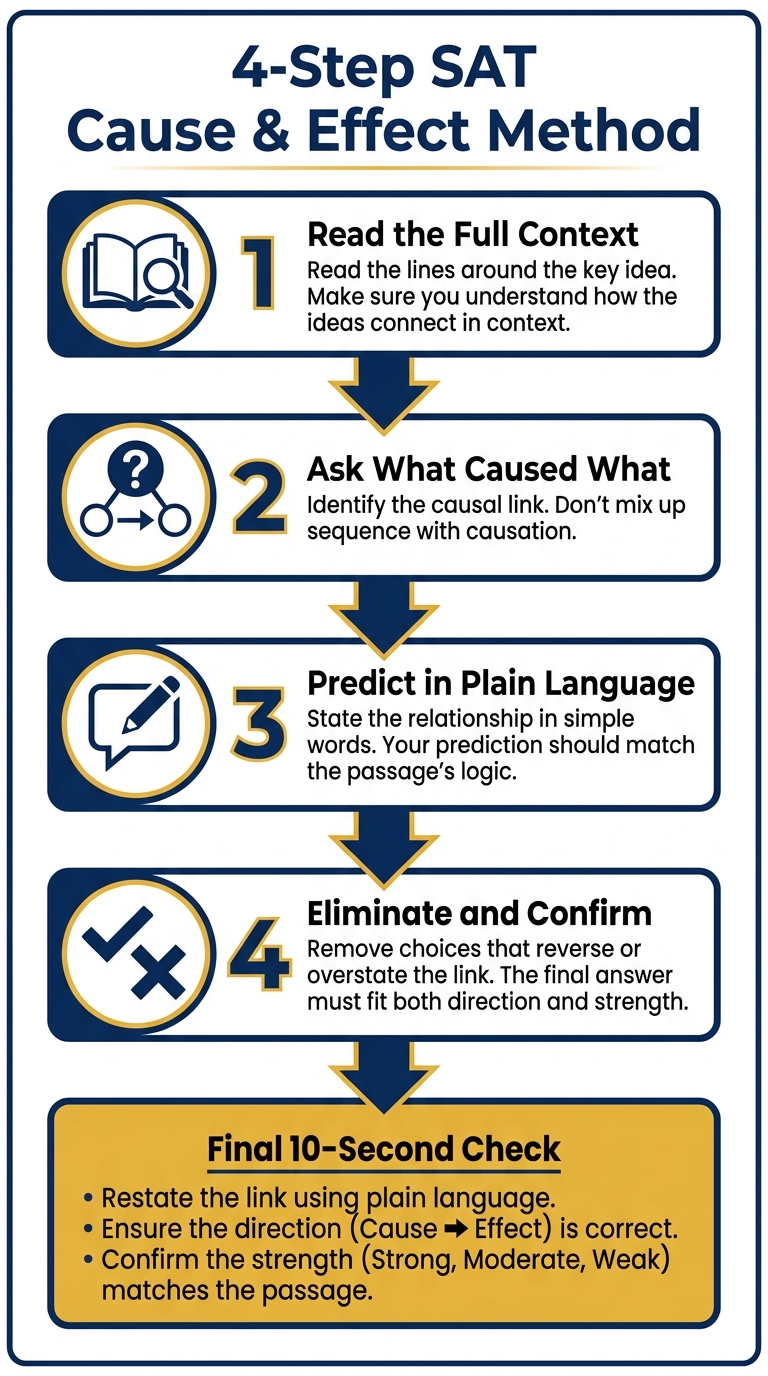
4-Step SAT Cause & Effect Method: Spot, Predict, Eliminate, Confirm
Once you spot a possible link in the passage, stick to the same four steps each time: read the context, identify the linked ideas, predict the relationship, and check the answer’s direction and strength. That keeps you from guessing.
Before you read the choices, say the relationship in plain language. Then use that prediction to cut answers that flip the relationship, overstate it, or add a cause the passage never supports. Your final answer should match both direction and strength.
Applying the Method Across Question Types
Use the same process for cause, effect, and relationship questions.
Decision Table: Causal Reasoning by Question Type
Use this quick checklist as you work.
| Step | What to Do | Final Check |
|---|---|---|
| Read the full context | Read the lines around the key idea. | Make sure you understand how the ideas connect in context. |
| Ask what caused what | Identify the causal link. | Don’t mix up sequence with causation. |
| Predict in plain language | State the relationship in simple words. | Your prediction should match the passage’s logic. |
| Eliminate and confirm | Remove choices that reverse or overstate the link. | The last answer should fit both direction and strength. |
Using Targeted Practice to Build the Method Into Habit
Reading the method once isn’t enough. You need repeated practice until it feels automatic. SAT Practice Bot offers skill-based practice and explanations to help reinforce this method [1][2].
Once the method becomes automatic, the next step is learning to spot trap answers that sound causal but aren’t.
Common Causal Traps and a Final Check Before You Submit
Once you can trace cause and effect in a passage, the next move is simpler: catch answer choices that sound right but never earn the claim.
Wrong-Answer Patterns That Look Right at First
A lot of wrong answers borrow the language of logic without the proof. They may sound smooth on first read, but they stretch past what the passage shows.
Watch for these traps:
- Flipped cause and effect: the answer reverses the relationship. The passage says A led to B, but the choice acts like B led to A.
- Time-order traps: the answer treats something that happened first as the cause just because it came earlier.
- Pattern traps: the answer sees repetition or correlation and treats it like proof of causation.
Also check the strength of the claim. If the passage says one factor contributed to an outcome, don't pick an answer that says it fully caused that outcome. On the digital SAT, that kind of overstatement is a classic miss.
Use the final check below to catch these errors fast.
A 10-Second Final Check for Cause-and-Effect Answers
Run this quick mental test before you submit:
- Restate the link using because or so.
- Make sure the cause leads to the effect, not the other way around.
- Match the answer's strength to the passage's wording.
If that restatement sounds forced, backward, or too strong, the answer is probably off.
FAQs
How can I tell correlation from causation fast?
Look for a clear, logical link between the two events. Correlation means two things happen at the same time, while causation means one directly causes the other.
If you can't point to a clear process or reason that shows how one event would lead to the other, you're probably looking at correlation, not causation.
What should I do when the passage implies cause and effect?
Look for the chain of logic between ideas, even when transition words aren’t there. Your job is to track the reasoning or sequence that leads to the outcome.
SAT Practice Bot can help you practice this skill with targeted questions and detailed explanations, so you get better at spotting these less obvious connections on the digital SAT.
How do I avoid choosing a reversed answer?
Carefully track the direction of the cause-and-effect relationship in the passage. A reversed answer flips the link and treats the result as the cause, or the cause as the result.
Before you choose, check that the passage shows the first event leading to the second - not the second leading back to the first.