
Cross-Text Connections on SAT: Worked Examples
Four-step routine—summarize, compare, predict, check—with worked SAT cross-text examples and error categories.
Cross-Text Connections on SAT: Worked Examples
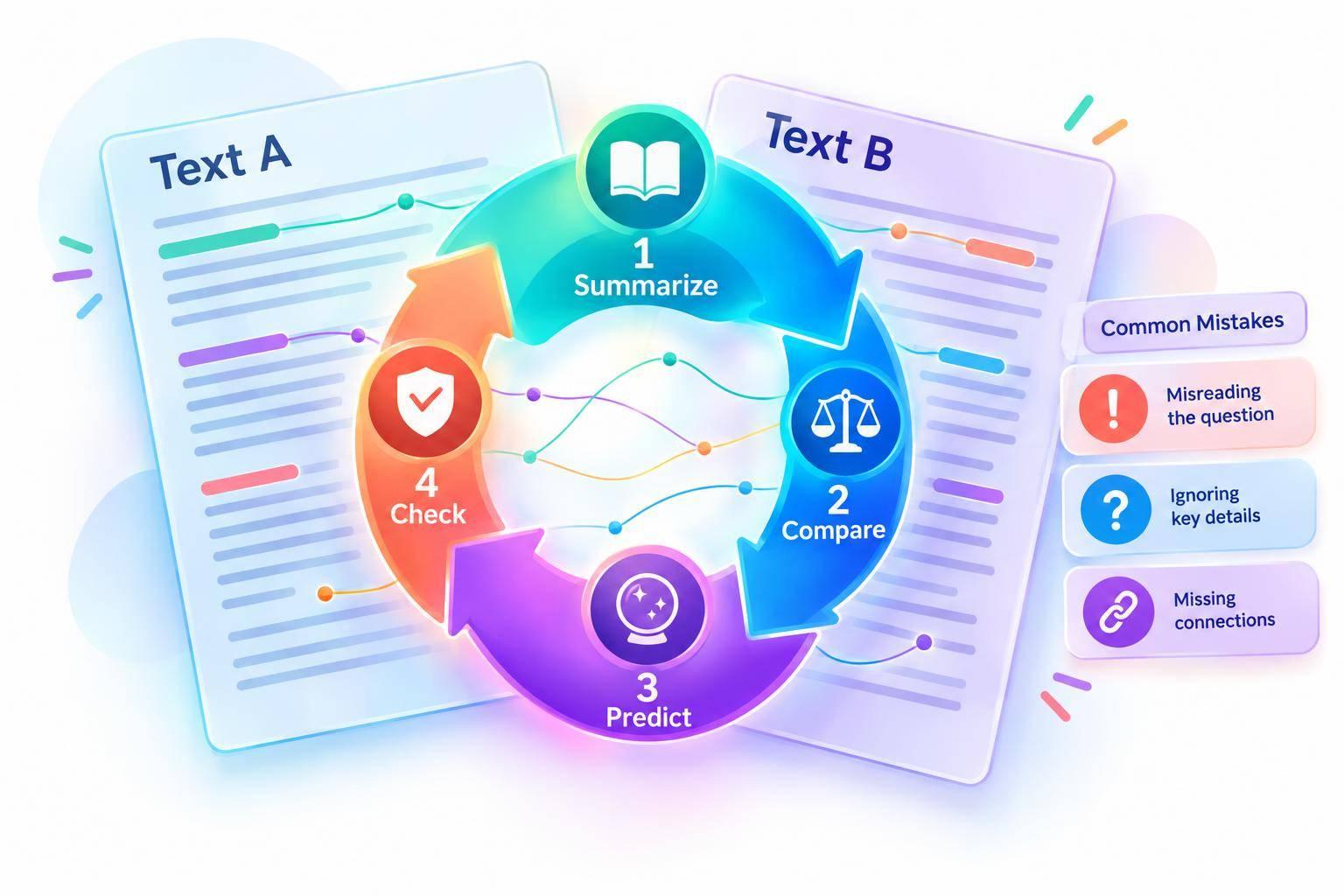
For SAT Cross-Text Connections, I compare what each author claims - not just what both texts discuss. My 4-step routine is simple: summarize, compare, predict, check.
- Find the shared claim: What would both authors agree on?
- Spot the limit: An added condition can qualify a claim without rejecting it.
- Check the whole answer: Reject choices that exaggerate, contradict a text, or add unsupported details.
In the original SAT-style examples below, I show why “can improve” does not mean “always improves” and why a maintenance requirement changes the comparison. When I review mistakes, I sort them into claim errors, relationship errors, or unsupported details.
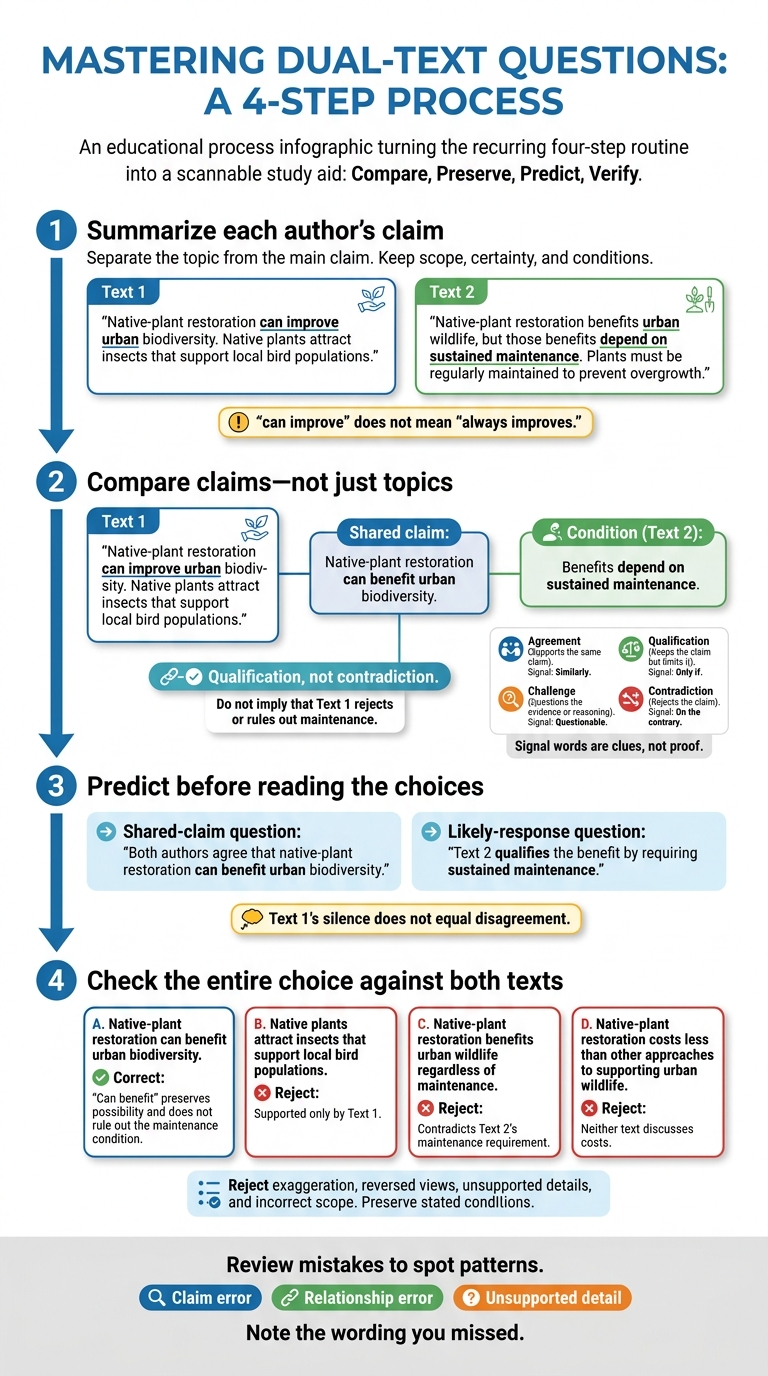
SAT Cross-Text Connections: 4-Step Strategy
Identify and Compare Each Text's Claim
Read each text on its own. Note what it claims, where that claim applies, and how certain the author sounds. Then compare the pair.
Separate the Topic From the Main Claim
The topic names the subject. The main claim states the author’s position.
Text 1: Native-plant restoration can improve urban biodiversity.
Text 2: Native-plant restoration improves biodiversity. Benefits are dependent on sustained maintenance.
An answer choice may match the topic but miss the claim. Focus on what each author says about the subject.
| Passage | Main Claim | Conditions |
|---|---|---|
| Text 1 | Native-plant restoration can improve urban biodiversity. | Applies to urban settings; can means possibility, not a guarantee. |
| Text 2 | Native-plant restoration improves biodiversity. | Benefits depend on sustained maintenance. |
Keep these limits in your summary. Changing can improve to always improves overstates Text 1. Leaving out maintenance removes Text 2’s central condition.
Once you understand both claims, check whether Text 2 agrees with, qualifies, or challenges Text 1.
Distinguish Agreement From Qualification and Disagreement
Compare the authors’ positions, not just their shared words. Both texts recognize biodiversity benefits, but Text 2 adds a requirement. That makes its claim a qualification, not a contradiction.
| Relationship | Meaning | Possible Signal |
|---|---|---|
| Agreement | Supports the same claim. | Similarly |
| Qualification | Keeps the claim but limits it. | Only if |
| Challenge | Questions the evidence or reasoning. | Questionable |
| Contradiction | Rejects the claim. | On the contrary |
Signal words are clues, not proof. However may introduce a condition rather than disagreement. Read the full clause before deciding.
Let the question guide your comparison:
- Shared claim: Find what both authors agree on.
- Contrast: Identify how their positions differ.
- Likely response: Decide whether one author would agree with, qualify, or contradict the other’s claim.
Eliminate choices that overstate either claim, contradict the texts, or add limits the authors never mention.
Worked Example 1: Find the Shared Claim
Original SAT-style practice question based on the native-plant claims.
Use the summarize–compare–predict–check routine.
Text 1: Native-plant restoration can improve urban biodiversity. Native plants attract insects that support local bird populations.
Text 2: Native-plant restoration benefits urban wildlife, but those benefits depend on sustained maintenance. Plants must be regularly maintained to prevent overgrowth.
Based on the texts, what would both authors most likely agree on?
A. Native-plant restoration can benefit urban biodiversity.
B. Native plants attract insects that support local bird populations.
C. Native-plant restoration benefits urban wildlife regardless of maintenance.
D. Native-plant restoration costs less than other approaches to supporting urban wildlife.
Find the Overlap and Predict the Answer
| Passage | Central Claim | Support | Claim |
|---|---|---|---|
| Text 1 | Native-plant restoration can improve urban biodiversity. | Native plants attract insects that support local birds. | Describes a possible benefit. |
| Text 2 | Native-plant restoration helps urban wildlife when maintenance is sustained. | Regular maintenance prevents overgrowth. | Agrees on the benefit but adds a condition. |
Predict: both authors agree that native-plant restoration can benefit urban biodiversity.
Now check each choice against both texts, not just one.
Eliminate Choices Without Support From Both Texts
A is correct. “Can benefit” matches Text 1’s “can improve” without ruling out Text 2’s maintenance requirement.
B has support only in Text 1. Text 1 connects insects to local bird populations. Text 2 doesn’t mention that connection.
C contradicts Text 2. “Regardless of maintenance” conflicts with the statement that benefits “depend on sustained maintenance.”
D has no support in either text. Neither author discusses costs.
Worked Example 2: Identify Text 2's Qualification
This example moves from finding shared claims to explaining how Text 2 qualifies a shared idea. The method stays the same; only the question changes. When asked how Text 2 would respond, decide whether it agrees, qualifies, or disagrees with the claim. Predict the response before reading the choices.
Predict How Text 2's Author Would Respond
Instead of finding the shared claim again, focus on the limit Text 2 adds.
| What to check | What it tells you |
|---|---|
| Shared claim | The texts may agree on the main point. |
| Limiting language in Text 2 | Text 2 qualifies the claim rather than rejects it. Text 1’s silence does not equal disagreement. |
Here, Text 2 makes the benefits depend on sustained maintenance. That condition signals a qualification, not a rejection.
Check Every Part of Each Choice
The correct choice must match Text 2 and keep its maintenance requirement. Eliminate choices that overstate disagreement, leave out that condition, or add claims the texts don’t support.
A choice that merely repeats a related detail is wrong if it doesn’t explain how Text 2 responds to Text 1. Check every part of the choice against both texts.
Conclusion: Support Your Answer With Both Texts
Check the entire answer choice against both texts. Text 2’s maintenance condition limits the shared claim; it doesn’t cancel it.
Use a Short Checklist Under Time Pressure
Follow the same identify–compare–predict–check steps used in the examples. Summarize each text in a few words, find the shared claim and key difference, predict the answer, and check every choice against both texts.
Reject choices that reverse the authors’ views, overstate their claims, add unsupported details, or get the scope wrong. If the answer depends on a condition, reread the exact wording that states it.
Review Your Errors During Practice
After each question, record mistakes in your log so you can spot patterns. After practice, label each miss as a claim error, relationship error, or unsupported detail, and note the wording you missed.
FAQs
What if a passage’s main claim is implied?
Find the implied claim by looking at the passage’s reasons and evidence. State the claim in one sentence, then ask whether the evidence supports it. A gap between the evidence and the claim often points to an assumption the author hasn’t stated.
Choose the answer that matches the passage’s exact claim, not a broader or stronger statement the text doesn’t support.
How do I compare texts with different evidence?
Map each author’s claim, reasons, and evidence separately - don’t treat the two passages as one argument [1][2]. Label the evidence in each text as facts, data, examples, or expert opinions [1].
Next, compare where the authors agree, disagree, or share common ground. Decide which argument has stronger support by checking the quality of its evidence, how well the reasoning connects that evidence to the claim, and whether the author addresses the opposing view [1].
How do I choose between two plausible answers?
Go back to the passage and check every part of each answer choice for direct support. On the digital SAT, even a small mismatch can make an answer wrong. If you don’t find more evidence, choose the option with stronger overall support. Focus on the author’s main purpose, not minor details.
Still unsure? Mark the question for review, move on, and return if time allows.