
Text Structure and Purpose: SAT Guide
Three-step read→predict→check method to spot passage patterns, define author purpose, and avoid common SAT Reading traps.
Text Structure and Purpose: SAT Guide
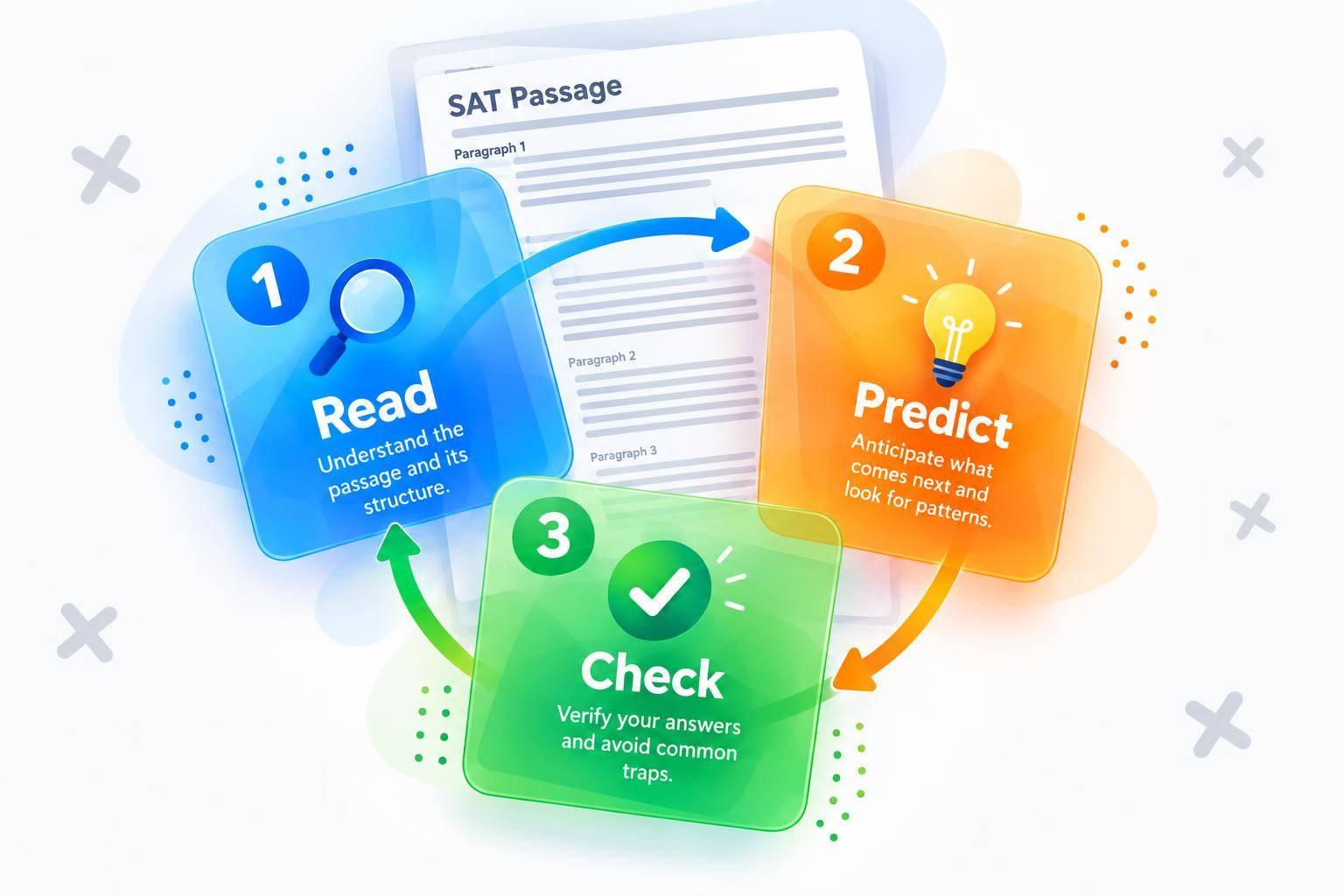
I use 3 steps for SAT Text Structure and Purpose questions: read, predict, and check. First, I track how the ideas connect. Then I state what the author is doing and check each part of my answer against the passage.
In this guide, I cover:
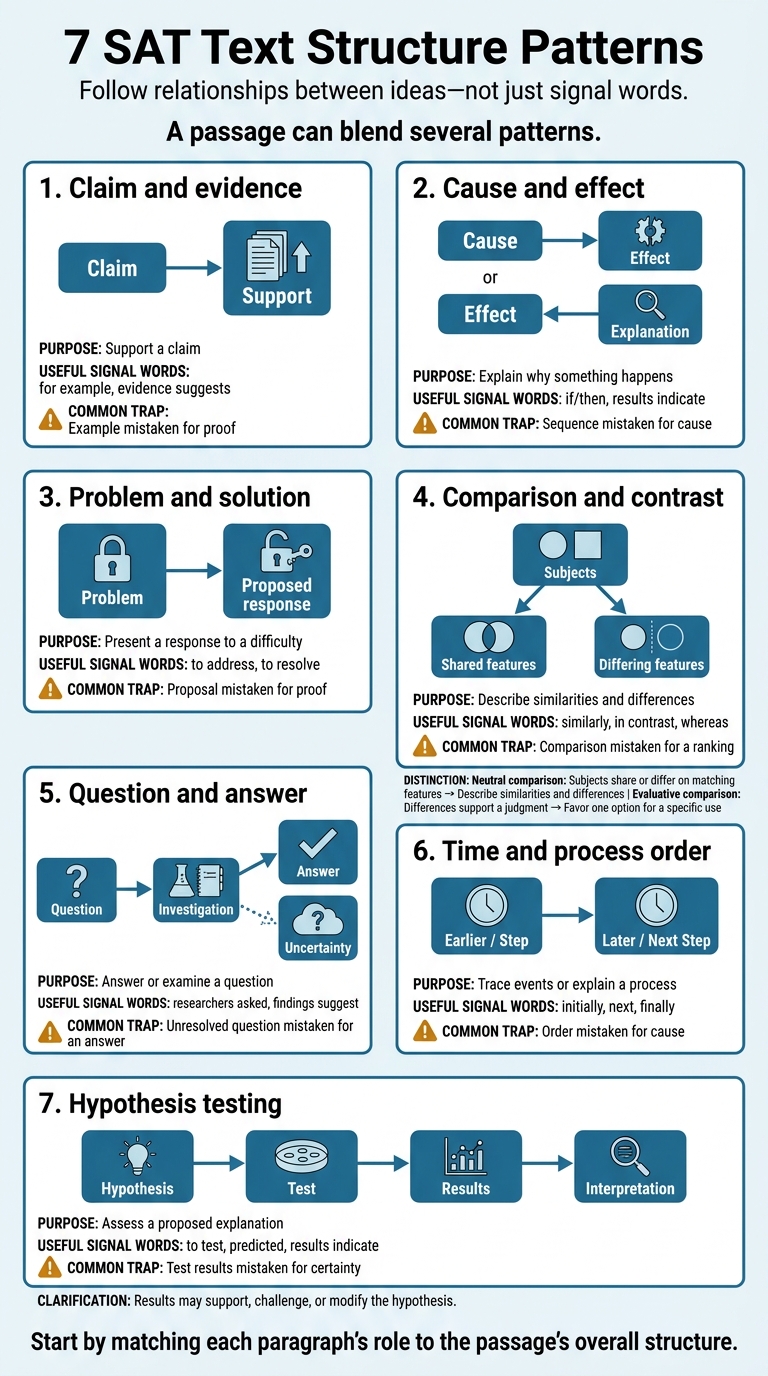
- 7 passage patterns: claim and support, cause and effect, problem and solution, comparison and contrast, question and answer, time and process order, and hypothesis testing.
- Purpose vs. function: the author’s goal for the whole passage versus one sentence’s role.
- Answer traps: choices that confuse the topic with the purpose, overstate a claim, or misread a connection.
- Practice and review: when to flag a question, how to log mistakes, and how to use SAT Practice Bot explanations.
My rule: follow the relationships between ideas, not just signal words - and reject any choice with an unsupported part.
7 Common Passage Patterns
7 SAT Text Structure Patterns
Once you know each paragraph’s role, identify the passage’s pattern. A passage can blend several patterns. Signal words offer clues, but relationships between ideas matter most. [3] Use these patterns to spot what the author is doing before reading the answer choices.
| Pattern | Typical sequence | Useful signal words | Purpose | Common trap |
|---|---|---|---|---|
| Claim and evidence | Claim → support | for example, evidence suggests | Support a claim | Example mistaken for proof |
| Cause and effect | Cause → effect, or effect → explanation | if/then, results indicate | Explain why something happens | Sequence mistaken for cause |
| Problem and solution | Problem → proposed response | to address, to resolve | Present a response to a difficulty | Proposal mistaken for proof |
| Comparison and contrast | Subjects → shared or differing features | similarly, in contrast, whereas | Describe similarities and differences | Comparison mistaken for a ranking |
| Question and answer | Question → investigation → answer or uncertainty | researchers asked, findings suggest | Answer or examine a question | Unresolved question mistaken for an answer |
| Time and process order | Earlier → later, or step → next step | initially, next, finally | Trace events or explain a process | Order mistaken for cause |
| Hypothesis testing | Hypothesis → test → results → interpretation | to test, predicted, results indicate | Assess a proposed explanation | Test results mistaken for certainty |
Start by matching each paragraph’s role to the passage’s overall structure.
Claim and Evidence, Cause and Effect, Problem and Solution
For claim and evidence, check whether data or examples support the claim or just illustrate it. For cause and effect, look for why something happened - not just what happened afterward. For problem and solution, identify the problem, then the proposed fix.
Comparison and Contrast, Question and Answer
Look for shared and differing features, even when there are no clear transition words. A neutral comparison describes similarities and differences. An evaluative comparison uses those features to favor one choice.
| Pattern | Relationship between ideas | Possible purpose |
|---|---|---|
| Neutral comparison | Subjects share or differ on matching features | Describe similarities and differences |
| Evaluative comparison | Differences support a judgment | Favor one option for a specific use |
“Researchers asked” signals an inquiry. Check whether the findings answer the question or leave it open.
Time and Process Order, Hypothesis Testing
Time/process order tracks a sequence. Words such as “initially” and “next” show order, not proof of causation. Hypothesis testing examines whether a proposed explanation holds up. Identify the prediction, test, result, and interpretation. Results may support, challenge, or modify the hypothesis.
How Structure Reveals Purpose
Once you spot a passage’s pattern, identify what the author does. Build a purpose statement using the topic, how the ideas develop, and the author’s action.
The same structure can serve different purposes. A comparison, for example, may stay neutral or try to persuade. Look for the pivot - the point where description shifts to judgment or a problem leads to a proposed response.
Name the Author’s Action
Choose a precise verb: explain, evaluate, challenge, compare, propose, or illustrate. Use the verb the text supports, not the one that sounds strongest.
| Distinction | Textual support to look for |
|---|---|
| Explain or describe vs. argue or evaluate | Definitions, process details, and features explain or describe. A position backed by reasons argues; judgments about strengths and drawbacks evaluate. |
| Introduce a problem vs. propose a solution | Identifying a difficulty introduces a problem. Recommending a response proposes a solution. |
| Present evidence vs. use evidence to challenge a claim | Reporting findings presents evidence. Connecting those findings to an opposing claim challenges that claim. |
Connect a Sentence’s Role to the Passage’s Purpose
An overall purpose question asks what the whole passage accomplishes. A local function question asks how one sentence helps accomplish that goal. Identify whether the sentence supports, contrasts with, or qualifies an idea. A qualification limits a claim; it does not reject it.
A sentence about Scrum roles functions as supporting detail because it adds a specific feature of one framework within the comparison.
Reject Misleading Answer Choices
Check every part of an answer against the passage. Reject choices that are too broad, focus only on a minor detail, reverse the order of ideas, or misstate how those ideas connect.
Description does not establish endorsement, and mentioning a drawback does not automatically mean rejection. Words like proves, always, and obsolete need direct support. Even if an answer gets the topic right, the wrong author action makes it incorrect.
Apply these same checks when reviewing missed questions.
Solve Under Time Limits and Review After Grading
Read, Predict, and Check Your Answer
Read → predict → check. Start with the question stem: does it ask about structure, overall purpose, or sentence function? Briefly label each unit as claim, support, contrast, or qualification. Predict a short answer before looking at the choices, then check every clause of your selected answer against the text. Treat however and therefore as links between ideas - not shortcuts to an answer. This helps you track structure, purpose, and function under time pressure.
Flag and move on when rereading stops helping. If you’re stuck between two choices and can’t find new textual support, choose the better-supported answer and mark the question for review. Return if time remains. Leave detailed error analysis until after grading.
Review and Classify Your Mistakes
After grading, add each flagged question to an error log. Record the question type, chosen answer, correct answer, and time spent. Summarize each unit in a few words and identify the passage’s structure and purpose. Mark the exact word, qualification, transition, or relationship you missed. Explain why the correct answer fits and where your choice fails. Review correct guesses, too - a right answer doesn’t always mean sound reasoning.
Label each error as structure, topic vs. purpose, qualification, transition, or sentence function. For sentence-function errors, pinpoint how the sentence connects to nearby ideas. Track time separately so you can distinguish passage difficulty from reading speed. Use your diagnosis to set one practice goal, then try similar questions later.
Practice With SAT Practice Bot
Use the curated digital SAT Reading & Writing questions in SAT Practice Bot for focused practice. After grading, check its explanations to see whether you missed structure, purpose, or sentence function. Use the explanations, answer review, and progress tracking to update your error log. [1]
Key Takeaways
Once you’ve identified the passage’s structure and purpose, use these checks to review your answer faster.
- Follow how the ideas develop. Patterns and transitions offer clues, not fixed rules.
- Answer what the question asks. Function means a sentence’s role; purpose means the author’s goal for the whole passage.
- Reject an answer if even one part lacks support.
After grading your work, check your error log for your most common mistake. Identify the passage pattern, then choose the next skill to practice.
FAQs
How do I identify structure when passage patterns overlap?
When patterns overlap, identify each paragraph’s purpose: claim, evidence, comparison, cause, or solution. Then check the transitions. Contrast words point to comparison, “because/therefore” signals cause and effect, and references to a problem and a response point to problem-solution.
If a paragraph serves more than one purpose, use its main purpose to identify the structure. Use its secondary purpose only to predict the question type. When reviewing mistakes, connect each wrong answer to the paragraph purpose you misidentified. [1][2]
What if two purpose answers seem equally accurate?
Reread the passage to decide which option has stronger support overall. Focus on the author’s main purpose, not minor details. Look for keywords and clues in how the passage is organized that point to one choice.
If you use SAT Practice Bot, review the explanations after grading. Use them to understand why an answer is correct and how to tell similar choices apart in future practice.
How can I turn recurring mistakes into targeted practice?
After grading, use SAT Practice Bot’s answer review and explanations to see where your reasoning went off track. Watch for repeated mistakes, such as misreading a passage’s structure or missing a claim. Focus your next practice sessions on those weak points, and keep reviewing the explanations until you understand the concepts behind the answers.