
SAT Quadratic Equations: Practice Questions Explained
SAT quadratic functions and equations practice: 6 worked questions on factoring, square roots, the quadratic formula, vertex form, and zeros in word problems.
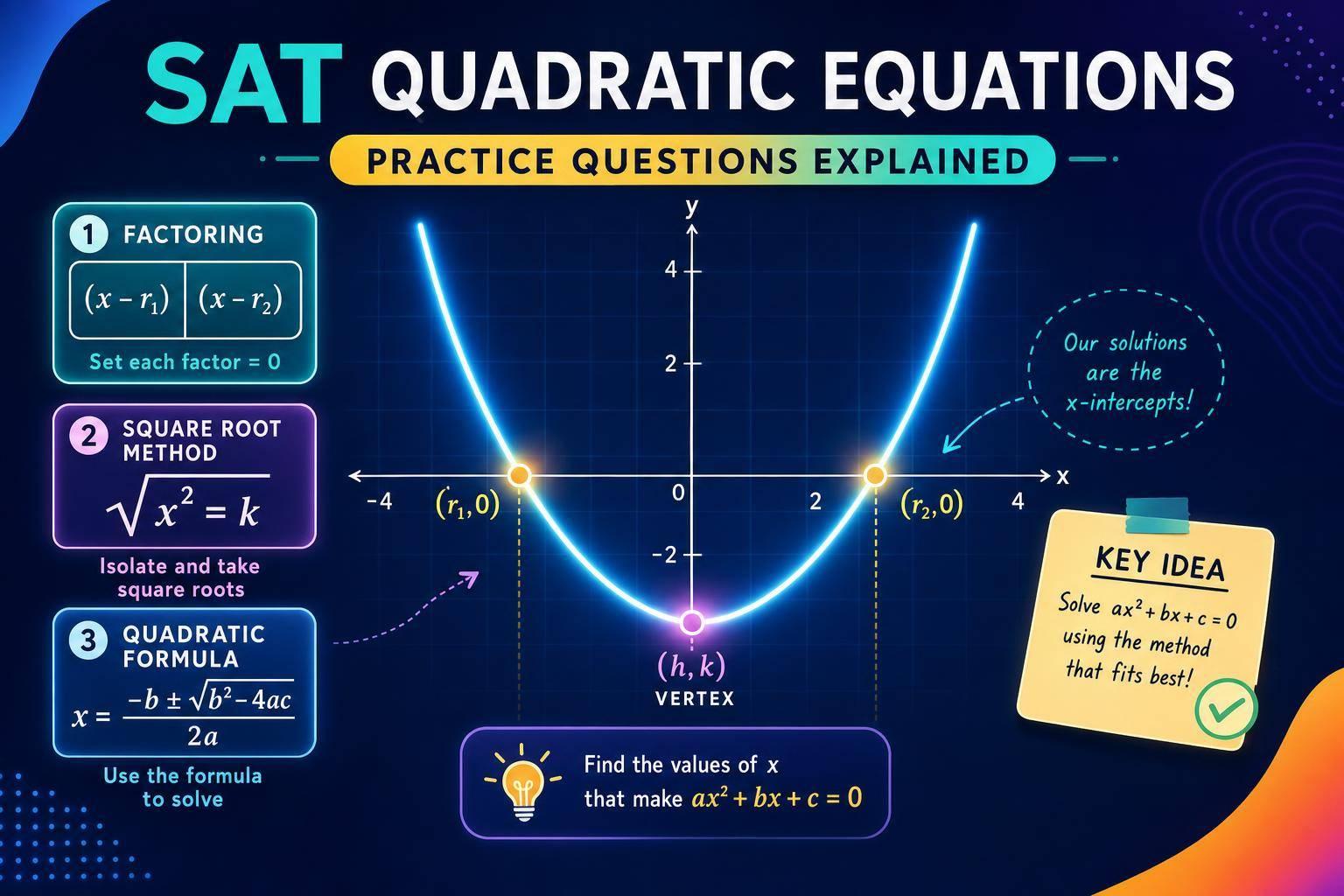
SAT Quadratic Equations: Practice Questions Explained
SAT quadratic questions usually ask you to solve an equation by factoring, using square roots, or applying the quadratic formula, or to read a quadratic function’s zeros and vertex in context. Most misses come from sign errors, dropping the ± sign, or answering the wrong part of the question. The six worked questions below cover each pattern.
Practice SAT quadratic functions questions and more Advanced Math practice.
Most SAT quadratic misses come from just 3 issues: sign errors, missing the ± sign, and answering the wrong part of the question. In this practice set, I see six common digital SAT patterns: factoring, grouping, square roots, the quadratic formula, zeros in context, and reading break-even points from factored form.
If you want the short version, here it is:
- I solve quadratics by first putting them in standard form when needed.
- I use factoring when the roots look clean.
- I use the square-root method for forms like x² = k.
- I use the quadratic formula when factoring does not work fast.
- In word problems, I check whether both roots fit the story.
A good checkpoint: every question in this set has two algebraic solutions, but not every question wants both as the final answer. Question 5 wants only one. That is a common digital SAT trap.
Here is the full skill map from the article in one glance:
- Question 1: factoring with a leading coefficient of 1
- Question 2: factoring when a ≠ 1
- Question 3: square roots and the ± rule
- Question 4: quadratic formula and the discriminant
- Question 5: zeros in a height model
- Question 6: break-even points and the vertex meaning
Bottom line: if you can factor cleanly, use it; if you see a squared expression alone, use square roots; if neither path is clean, go to the quadratic formula and check what the prompt is actually asking.
This article then walks through each of those six SAT-style cases step by step.
Practice Set 1: Factoring and the Zero-Product Rule
Question 1: Factoring a Quadratic in Standard Form
The question: Solve for all values of (x).
x² + 3x - 10 = 0
(A) (x = 2) only (B) (x = -5) only (C) (x = 2) and (x = -5) (D) (x = -2) and (x = 5)
Pause here and try it before reading the solution.
Correct answer: (C)
Start by finding two numbers that multiply to (-10) and add to (+3). Those numbers are (5) and (-2).
x² + 3x - 10 = (x + 5)(x - 2) = 0
Now use the zero-product rule: if two factors multiply to 0, at least one factor must equal 0.
Set each factor equal to 0:
- x + 5 = 0 ⇒ x = -5
- x - 2 = 0 ⇒ x = 2
So both values work.
Why the wrong answers are tempting:
- A and B each give just one root, but this equation has two.
- D uses the right numbers with the wrong signs.
Question 2 uses the same zero-product rule, but there’s one more step in the factoring.
Question 2: Factoring When the Leading Coefficient Is Greater Than 1
The question: Solve for all values of (x).
2x² - 7x + 3 = 0
(A) x = 3 and x = 1/2 (B) x = -3 and x = -1/2 (C) x = 3 only (D) x = 1/2 only
Pause here and try it before reading the solution.
Correct answer: (A)
Since the first coefficient is not 1, a good move is to split the middle term, then factor by grouping.
First, multiply a × c:
2 × 3 = 6
Now find two numbers that multiply to (6) and add to (-7). Those numbers are (-6) and (-1).
Rewrite the middle term:
2x² - 6x - x + 3 = 0
Group the terms:
[ 2x(x - 3) - 1(x - 3) = 0 ]
Factor out the common binomial:
[ (2x - 1)(x - 3) = 0 ]
Now set each factor equal to 0:
- 2x - 1 = 0 ⇒ x = 1/2
- x - 3 = 0 ⇒ x = 3
Both roots check out, so the answer is (A).
Why the wrong answers are tempting:
- (B) comes from a sign mistake. If you write ((2x + 1)(x + 3)), you get negative roots instead.
- (C) and (D) each stop after one root. That’s a common slip on the digital SAT - once you factor, make sure you test both factors.
Practice Set 2: Square-Root Method and Quadratic Formula
SAT Quadratic Equations: Which Method to Use?
Question 3: Solving x^2 = k and the Plus-or-Minus Rule
The question: Solve for all values of (x).
x² - 49 = 0
(A) (x = 7) only (B) (x = -7) only (C) (x = 7) and (x = -7) (D) (x = 7) and (x = 0)
Pause here and try it before reading the solution.
Correct answer: (C)
There’s no x term here, so the square-root method is the best move. First, isolate x²:
x² = 49
Now take the square root of both sides. This is where many students slip: you need the plus-or-minus sign.
x = ±√49 = ±7
So the solutions are (x = 7) and (x = -7). Both work in the original equation, so the answer is (C).
Why the wrong answers are tempting:
- (A) gives only the positive root.
- (B) gives only the negative root.
- (D) includes x = 0, but 0² - 49 ≠ 0.
A good habit: when you solve an equation like x² = k, write ± right away unless the problem gives a reason to use only one value.
Question 4: Applying the Quadratic Formula
The question: Solve for all values of (x).
2x² + 3x - 4 = 0
(A) x = (−3 ± √41) / 4 (B) x = (3 ± √41) / 4 (C) x = (−3 ± √23) / 4 (D) x = (−3 ± √41) / 2
Pause here and try it before reading the solution.
Correct answer: (A)
When factoring doesn’t jump out, the quadratic formula is the safe choice. Start by reading off the values of (a), (b), and (c):
a = 2, b = 3, c = -4
Now plug them into the formula:
x = (−b ± √(b² − 4ac)) / 2a
Work out the discriminant first:
b² - 4ac = (3)² - 4(2)(-4) = 9 + 32 = 41
Now substitute:
x = (−3 ± √41) / (2(2)) = (−3 ± √41) / 4
That matches (A).
Why the wrong answers are tempting:
- (B) changes (-b) into (+b).
- (C) uses the wrong discriminant.
- (D) uses the wrong denominator.
If you want fewer mistakes, write the full formula first, then substitute one piece at a time.
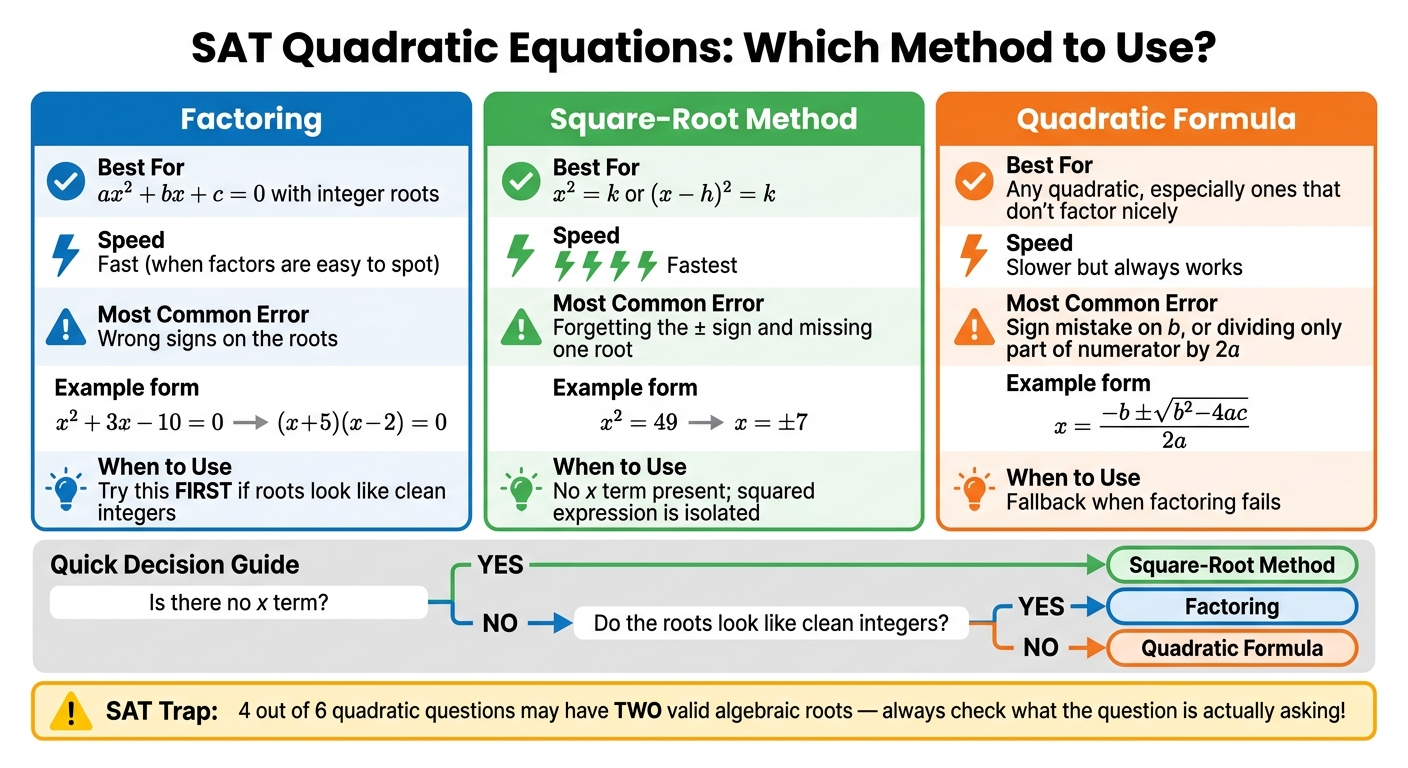
Method Comparison: Factoring, Square Roots, or the Quadratic Formula
Question 4 shows the fallback method that always works. This chart helps you choose the best method on test day.
Use the shape of the equation to decide what to try first.
| Method | Best equation form | Speed on the digital SAT | Most common error |
|---|---|---|---|
| Factoring | ax² + bx + c = 0 with integer roots | Fast when the factors are easy to spot | Wrong signs on the roots |
| Square-root method | x² = k or (x - h)² = k | Fastest | Forgetting the ± and missing one root |
| Quadratic formula | Any quadratic, especially ones that do not factor nicely | Slower but always works | Sign mistake on (b), or dividing only part of the numerator by (2a) |
These same methods show up in word problems too, but then you also have to check whether both roots make sense in context.
Quadratic functions on the SAT: zeros, vertex, and graphs
A quadratic function like f(x) = a(x − h)² + k or f(x) = a(x − r)(x − s) gives different information in each form. In vertex form you read the vertex (h, k) directly. In factored form you read the zeros r and s directly. If a is positive the parabola opens up, and if a is negative it opens down. Questions 5 and 6 below practice reading these values in context.
Is the quadratic formula given on the SAT?
No. The College Board reference sheet in Bluebook lists geometry formulas but not the quadratic formula, so memorize x = (−b ± √(b² − 4ac)) / 2a. You can also graph the function in the built-in Desmos calculator to check zeros.
Practice Set 3: Quadratic Functions in Context
Now use the same solving skills on interpretation questions. On the digital SAT, the algebra matters, but it’s not the whole job.
Many SAT word problems want more than the roots. You may solve a quadratic and get two answers, but only one may fit the story.
Question 5: Interpreting Zeros in a Word Problem
The question: A ball is launched upward from the ground. Its height in feet after (t) seconds is modeled by:
h(t) = -16t² + 64t
At what time does the ball return to the ground?
(A) (t = 0) (B) (t = 4) (C) (t = 0) and (t = 4) (D) (t = 2)
Pause here and try it before reading the solution.
Correct answer: (B)
Set (h(t) = 0) and solve:
-16t² + 64t = 0
Factor out (-16t):
[ -16t(t - 4) = 0 ]
So (t = 0) or (t = 4). Both work in the algebra. But the question asks when the ball returns to the ground. At (t = 0), the ball starts on the ground. At (t = 4), it comes back down. So the answer is (B).
Why the wrong answers are tempting:
- (A) uses the launch time, not the landing time.
- (C) gives both roots without checking what the question asks.
- (D) is the time when the ball reaches its highest point, not when it hits the ground.
Do the math first. Then check the meaning.
Next, use factored form to read zeros and make sense of the parabola.
Question 6: Reading Zeros and Values from Factored or Vertex Form
The question: A company's weekly profit in dollars is modeled by:
[ P(x) = (x - 3)(x - 9) ]
where (x) is hundreds of units sold. For what values of (x) does the company break even, and what does the vertex of this parabola represent?
(A) Break-even at (x = 3) and (x = 9); vertex is the minimum profit point (B) Break-even at (x = -3) and (x = -9); vertex is the minimum profit point (C) Break-even at (x = 3) and (x = 9); vertex is the maximum profit point (D) Break-even at (x = 3) only; vertex is the minimum profit point
Pause here and try it before reading the solution.
Correct answer: (A)
Factored form gives the zeros right away. Set (P(x) = 0):
(x - 3)(x - 9) = 0 ⇒ x = 3 or x = 9
So the company breaks even at x = 3 and x = 9. Since the x² term would be positive after expanding, the parabola opens upward. That means the vertex is the minimum profit point. The answer is (A).
Why the wrong answers are tempting:
- (B) switches the signs, which is a common mistake in factored form.
- (C) gets the zeros right but misses the direction the parabola opens.
- (D) finds only one zero and misses the other one.
When you see factored form, each factor ((x - h)) gives a zero at (x = h).
Math Result vs. Context Meaning
Getting the algebra right is only half the task. The same result can mean different things depending on the situation.
| Algebraic result | What it means in the model | Does it answer the question? |
|---|---|---|
| (t = 0) from (h(t) = 0) | Ball is at launch | Only if the question asks about the starting moment |
| (t = 4) from (h(t) = 0) | Ball returns to ground | Yes, if the question asks when it lands |
| (x = 3) from (P(x) = 0) | First break-even point | Yes, if asking for all break-even values |
| (x = 9) from (P(x) = 0) | Second break-even point | Yes, if asking for all break-even values |
| Vertex (x = 6) in (P(x)) | Minimum profit between break-even points | Only if the question asks about the minimum |
Find all roots, then match them to what the question is asking.
Answer Review: Common Mistakes and How to Fix Them
After the practice questions, use this review to spot the pattern behind each miss. On Digital SAT quadratic questions, most wrong answers come from a small set of repeat mistakes, not tough algebra.
Why Wrong Answers Happen
The main errors are easy to predict: sign mistakes, missing the ± sign, and giving the wrong quantity in word problems. A lot of students do the math right and still miss the question because they answer something different from what the prompt asks.
Quick Checklist Before You Lock In an Answer
Use this checklist to catch the mistake before you submit. Check these five things:
- Did you check the signs carefully?
- Did you factor correctly?
- Did you remember the plus-or-minus when needed?
- Does your answer match the question?
- Did you check it in the original equation?
- Did you graph it? In the built-in Desmos calculator, the x-intercepts of y = (your quadratic) are the solutions.
SAT Practice Bot offers curated Advanced Math practice and explanations after grading to help you review recurring mistakes (try free Advanced Math questions). Tracking your most-missed step shows what to fix.
Conclusion: Habits That Improve Accuracy on Quadratic Questions
Quadratic accuracy comes from three habits: show every step, check your signs, and re-read the question after you solve. Show every step, check your signs, and match your result to the question before you lock in your answer. Quadratics often show up inside systems questions too. See Substitution and Elimination: Practice Questions. You can also check zeros in Desmos.
FAQs
How do I know which method to use first?
First, look at the equation’s form. If it factors cleanly, factoring is often the fastest way to solve it. If not, the quadratic formula is the safest choice because it works for any quadratic equation.
If the linear term is missing, or if the equation already looks like a perfect square, taking the square root or completing the square can save time. You can practice these methods with the free samples on our Advanced Math practice page.
When should I keep both roots?
Keep both roots if both work in the original equation and fit the situation. On the digital SAT, check for extraneous solutions by plugging each root back into the original equation.
If a root gives an impossible value, like a negative length or negative time, throw it out. If both work, keep both.
How can I avoid sign mistakes on SAT quadratics?
Distribute negative signs carefully to every term inside the parentheses. A small sign mistake can throw off the whole problem, so it helps to slow down here and check each term one by one.
After you solve, plug your answers back into the original equation. That quick check can catch errors fast and show whether your work holds up.
Steady practice also helps you notice patterns in your mistakes. Over time, that makes your work more precise and helps you solve quadratic problems with fewer slip-ups.